The Full Cycle: From Niche Markets to Harvest

The defense tech market is a case study of how an emerging niche market runs through an investment cycle. What began as niche venture capital bets into a number of small—and risky—government contractors just five years ago is now a mainstream institutional asset class with a clearly demonstrated exit cycle. The data tells a compelling story: the seeds planted in 2021-2022 are now being harvested from unicorns through M&A deals, IPOs, and increasingly via secondary markets. For investors, this story serves as compelling empirical evidence for allocation into this sector.
This transformation reveals three important truths about dual-use and defense technology investing: (1) generational geopolitical shifts and government demand drivers are creating a structural and enduring investment opportunity for dual-use technology investing; (2) the cycle from early-stage funding to liquidity is compressed when compared to other sectors; and (3) companies that will be great in 2030 are being built at seed and Series A today.
This blog provides the roadmap and empirical examples of this cycle, which undergirds the investment thesis Veteran Ventures Capital established in Fund I, and continues through our Fund II and SPVs.
The Seeds (2021-2022)—Patient Capital Planted In An Emerging Sector
Five years ago, investing venture capital into defense tech was genuinely contrarian. The sector was hard to understand, illiquid, heavily regulated, confined to a small circle of specialized investors and centered around an unattractive customer. In this environment, a small number of VC firms began deploying capital into a small number of companies building space capabilities, a range of autonomous systems, AI for defense, advanced manufacturing capabilities, and cyber resilience, among others. In retrospect, it’s clear these investments were not moonshots; they were solving real problems. This was VC working at it’s finest—using a unique perspective to predict problems and challenges the Pentagon didn’t fully appreciate and assume the risk government contracting offices would avoid. Put differently, this was VC leaning in to build the equipment to fight the next war, rather than continue to fund the companies that helped us fight the last one.
That early capital is now proving prescient. The investors who committed to defense tech when it was viewed with skepticism by broader venture are seeing private valuations that appreciated well in excess of other sectors since. The poster child for this evolution is Anduril Industries, which went from roughly $7 billion in valuation in 2022 to $61 billion today—an 8.7x multiple in less than four years--still as a private company, with an IPO looming. Importantly, Anduril isn’t a one-off; dozens of other companies have similar stories and trajectories, with many current or pending liquidity events providing a pathway for their investors to see meaningful returns.
The Inflection (2025-Present)—Records and Mega-Rounds
The shift from 2024 into 2025-2026 is sharp and unmistakable. Venture capital funding for defense tech startups hit an all-time high in 2025, and 2026 is tracking to match or exceed those records. Nearly 90 new defense tech companies achieved unicorn status in 2026 alone—a significant acceleration from historical norms. More importantly, investors are funding mega-rounds designed to build factories, buy infrastructure, and create enduring capacity: Series B and C rounds in the $50M-$150M range are now commonplace, reflecting both capital abundance and the pull-through demand from government procurement. This capital is conviction capital buttressed from hard facts, loosely grouped in three categories.
First, the dual-use thesis is getting tailwind from both the private and defense sectors. The same companies selling goods to the Pentagon are the same vendors supporting the US’s reindustrialization push—providing a broader and deeper set of customers that have demand measured by many years, rather than quarters. The aviation sector alone serves as an excellent example. Well over 1,000 Airbus and Boeing jets didn’t get build as a result of Covid, and airlines are waiting over a decade to get aircraft deliveries. Those same companies also need to build defense systems, including manned and unmanned aircraft—which is similarly at record demand. This is a backlog that is both structurally enduring and creates space for newcomers into the market.
Second, the world is not becoming a safer place. With conflicts involving both the US and her allies/partners around the globe, the demand for US defense systems is coming from every corner. Japan, for example, just passed it’s 14th consecutive record defense budget. However, due to decades of under-investment, few countries outside the US have the capacity to meet domestic demand and export—creating a structural tailwind for foreign demand for US defense products. This focus on US goods is sharpened by the poor showing of Russian weaponry in Ukraine—fewer countries are willing to buy those systems, shifting demand to western companies. Additionally, the depletion of the US’s weaponry over the last 18 months will take years to replenish, providing enduring demand. Again, these conditions are sufficiently enduring that they represent the opportunity for newer entrants to enter this marketplace; indeed, the Pentagon has explicitly stated and made structural changes to welcome companies outside the traditional large primes.
Third, The Pentagon's supply chain reshoring mandate—the aggressive push to move defense manufacturing and supply chain back to the U.S. and reduce dependence on other countries—created a significant demand signal for domestic suppliers. Established defense contractors are now actively acquiring capability-gap startups rather than building in-house. Venture-backed founders are seeing acquisition interest from Lockheed Martin, Northrop Grumman, L3Harris, RTX, and others at accelerating velocity. This re-shoring is highly unlikely to change regardless of political shifts in power in the US; once US suppliers are created, politicians will be loathe to open the door for Chinese competitors for those US companies.
The Stories Behind the Data: Eight Companies Illustrating the Cycle
- Anduril Industries ($61B Valuation): Founded in 2017, Anduril is now valued at $61B with an anticipated IPO in 2026 at $60B+. It is the poster child for venture-scale defense tech: government customer, massive TAM, AI-driven autonomous systems, and a path to public markets.
- Palantir Technologies ($2.1T Market Cap, Post-IPO): Palantir went public in 2020 at $10B valuation and is now worth approximately $2.1T. Early investors saw 200x+ multiples from seed/Series A entry points.
- Planck Aerosystems (Acquired by AeroVironment, 2022): Demonstrated rapid consolidation for venture-backed teams in autonomous aircraft navigation.
- Tomahawk Robotics (Acquired by AeroVironment, 2022): Ground autonomy company showing how serial acquirers build platforms through bolt-on M&A.
- ForgeRock (Acquired by Ping Identity/Thoma Bravo, 2024): Venture-backed unicorn consolidated through PE-backed merger.
- BlueHalo ($4.1B Acquisition by AeroVironment, 2024): One of the largest defense tech M&A deals, signaling how much large primes pay for venture-backed tech.
- Mandiant (Acquired by Google/Alphabet, $5.4B, 2022): One of the largest cybersecurity acquisitions ever.
- Splunk (Acquired by Cisco, $28B, 2024): Journey from $20/share IPO to $157/share acquisition represents 100x+ returns for early Series A-B investors.
The Harvest (2026 Onwards)—Liquidity Events Accelerating
As mentioned earlier, VCs investing 5 years ago are enjoying the early phases of the harvest. Dual-use deals are enjoying a fairly balanced series of liquidity events across IPOs, M&A and secondary markets.
The IPO Window: The US IPO market overall in 2026 already raised $251B across 86 deals. Dual-use darling SpaceX shines here, having raised $75B in its IPO. While SpaceX was raising funds as early as 2002, according to Traxn approximately 77% of all of SpaceX funding came since Feb 2020. Its mammoth IPO dimmed other exceptional dual-use tech IPOs in the last six months, including Swarmer, Voyager Technologies, and Hawkeye 360. Importantly, several other significant IPOs are in the pipeline, including Anduril, True Anomaly, Quantum Space, Relativity Space, Shield Axiom Space, Sierra Space and Axon Vision. This analysis excludes the massive IPO from AI companies with defense applications, including Anthropic, OpenAI, DataBricks and the European firm Mistral AI.
Two takeaways worth considering. First, this pipeline of defense tech reflects a segment that is de-risked: government customers, long-term contracts, high margins can support public market investment, rather than early-stage risk requiring VC investments. Second, the wave of liquidity being recycled into LPs coffers will provide the option for LPs to recycle that capital into companies raising at their Series A, B & C rounds in the coming months and years.
The M&A Surge: Defense tech M&A is accelerating; according to White & Case, 98 major acquisitions occurred since 2020, accelerating both in size and number since 2022. Acquisition multiples are healthy averaging 7-10x EBITDA for lower-tech hardware, with premium deals featuring high-tech hardware with an AI wrapper clustering in 15-20x EBITDA range. Niche deals are enjoying 22-24x EBITDA multiples. 2026 is continuing the trend, with 14 deals with $1.2B, both figures well above those for the same period in 2025.
Top 10 M&A Acquisitions (2022-2026):
- Splunk ($28.0B)
- BlueHalo ($4.1B)
- Mandiant ($5.4B)
- Aerojet Rocketdyne ($4.7B)
- ForgeRock ($2.4B)
- Varonis ($2.1B)
- ESAero ($200M)
- Arcturus ($150M+)
- Planck ($100M+)
- Tomahawk ($90M+)
While the M&A pool is broad, serial acquirers are emerging. Since 2020, the top 5 companies building through bolt-on M&A include AeroVironment (7+ acquisitions), L3Harris (5+), Kratos Defense (6+), Ribbon Communications (8+), and Hexcel/Kaman (4+).
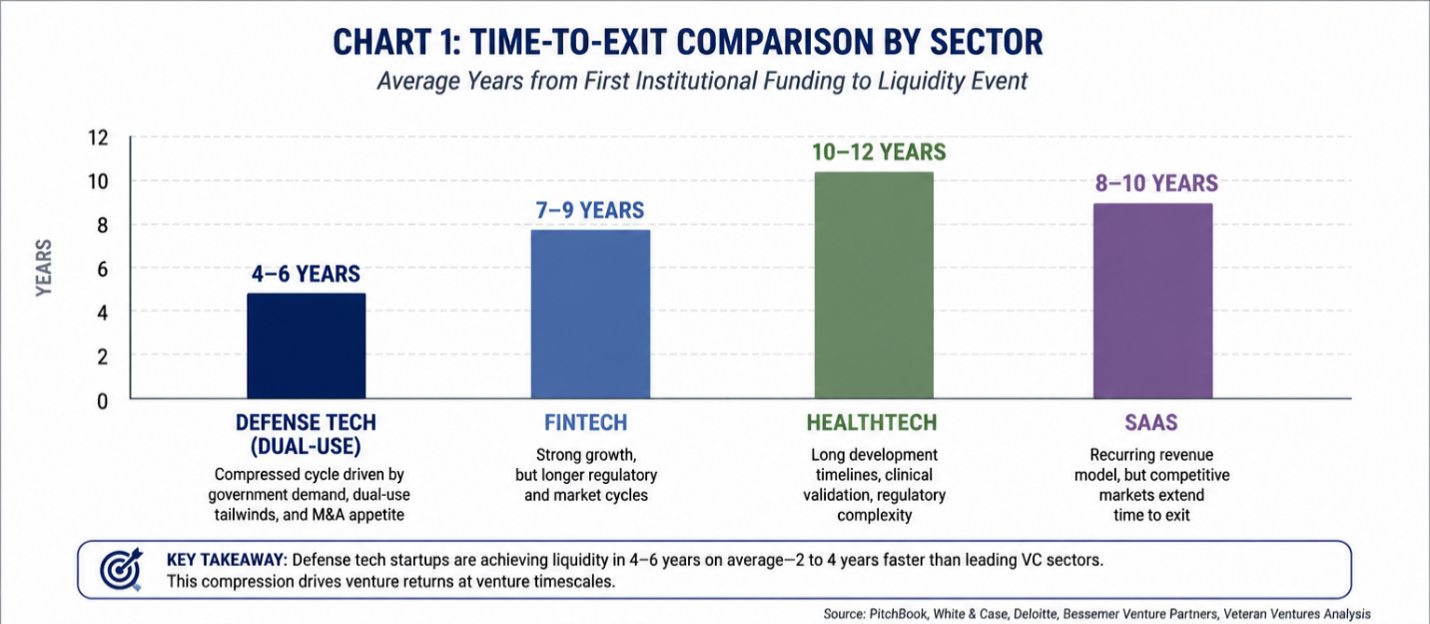
Perhaps the most germane metric for LPs is the compression of this market cycle, given the drought in DPI over the past 6 years. The venture-to-exit cycle in defense tech is now 4-6 years on average, versus 8-10 years historically. Fintech averages 7-9 years; healthtech averages 10-12 years. Defense tech's compression creates venture returns at venture timescales.
Secondaries: The secondaries market established itself as a credible and enduring liquidity pathway in the past three years, and in 2025 represented nearly 1/3 of all liquidity dollars. Secondaries have surged in 2026, with the overall market estimated at somewhere between $106-130B. While some of that flows to employees who are cashing in on their equity-based compensation, much of it also represents liquidity return to early VC investors through later-stage VCs and PE buyers. Continuation Vehicles (GP-led secondaries) accounted for ~20% of all PE/VC exits in 2025.
Not all is well with the emergence of secondaries. First, it allows companies to stay private longer, as early VCs get partial returns without forcing an IPO or an M&A deal. Additionally, secondaries typically price at 20-40% discounts to the latest round, eroding some returns. But in deals with early VCs have high double-digit TVPI and in need of liquidity, a market clearly exists despite the haircut.
The Great Companies of 2030 Are Seed and Series A Today
The 2021-2026 cycle we just witnessed is not a one-off event; rather, the structural causes underlying these developments will endure. Companies that we’re diligencing and investing in today we anticipate will be the best defense tech companies of 2030. They have two critical characteristics: (1) they solve problems the DoD will pay for, and (2) they are led by teams with deep domain expertise and venture discipline.
For LPs committed to venture returns in defense tech, the play is finding a VC that can find and fund at the Seed and Series A companies that will be acquired or go public in 2029-2030.
Conclusion: The Moment is Now
The earliest VC-funded defense tech is now in the harvest phase. The seeds planted in 2021-2022 are leading to liquidity events via acquisitions and IPOs, creating several multi-billion-dollar outcomes. The structural drivers—general reindustrialization, geopolitical tension, and Pentagon—are secular, not cyclical.
For venture LPs, the question is not whether to invest in defense tech. It is whether to invest now in the 4-5 year companies that will exit in 2027-2029, or watch early entrants capture venture returns while contractors acquire the best teams for billions.
The great companies of 2030 are being built today. The window to own them at seed and Series A valuations will not stay open long.
Share this article
Know someone who would find this valuable? Share it on LinkedIn.
Get updates like this in your inbox.
Subscribe to our newsletter — insights on defense tech, portfolio companies, and what we're watching.