The Shrinking Government Buyer
How the Pentagon paid for the first chapters of today's biggest technology markets, and why becoming a minority customer is the best news a defense investor could hear
The Lonely Halls
Over Labor Day weekend in 1973, the Pentagon was nearly empty. In a few borrowed offices, an Air Force colonel named Bradford Parkinson worked with about a dozen officers and engineers to save a program that had just been rejected.
Weeks earlier, Parkinson had briefed the Defense Systems Acquisition Review Council on the Air Force's satellite navigation concept, Project 621B. By his own account, the briefing failed badly. Parkinson was a Naval Academy graduate who had finished the digital fire-control system for a new AC-130 gunship and then flown combat missions over Southeast Asia to make it work. He did not take rejection as the end of the argument.1 Over that long weekend, the group redesigned the system from the ground up. It would use a constellation of satellites with atomic clocks, broadcasting signals that any receiver could use passively to fix its own position. By December the program was approved. On February 22, 1978, the first NAVSTAR satellite rose from Vandenberg on an Atlas booster, with Parkinson serving as launch commander.2,3
Historians still argue over how much of the design came from the Navy's earlier Timation work. That argument is worth reading.2 What nobody disputes is who the system was for: bombers, submarines, and missiles. It was a military system, paid for with military money, to solve military problems.
Then history turned. On September 1, 1983, a Soviet interceptor shot down Korean Air Lines Flight 007 after it strayed into Soviet airspace, killing all 269 aboard. Two weeks later, the White House announced that GPS would be made available to civilian aircraft once it was operational.4 When the Army went to war in the Persian Gulf in 1991, it did not have enough military receivers. It fielded roughly 4,000 commercial Trimble units and another 1,000 from Magellan, and some soldiers had their families mail them civilian sets.5 In May 2000, the government switched off the deliberate degradation of the civil signal, making civilian GPS up to ten times more accurate overnight.6
The result is one of the most lopsided ratios in technology history. By 2019 the world had about 6.4 billion satellite navigation devices installed. The U.S. military's standard handheld receiver had reached its 400,000th delivery almost a decade earlier.7 A study for the National Institute of Standards and Technology estimated that GPS had produced about $1.4 trillion in economic benefits for the U.S. private sector between 1984 and 2017.8 The government still spends roughly $1.8 to $2 billion a year on the GPS program, satellites, ground control, and military user equipment included.9 But for the receivers, the chips inside them, and the industry that makes them, the Pentagon has become a rounding error.
GPS is the cleanest example of a pattern that runs through almost every technology the defense establishment cares about. The Department of Defense was the patron, the first buyer, and for a time essentially the only buyer. Today it is a minority customer in a market it helped create. The six cases below show the same arc, each with its own data and its own complications.
The Pattern: The Government Didn't Leave. The Market Outgrew It.
One clarification before the case studies, because the thesis is easy to overstate. In most of these sectors, DoD did not stop buying. In several, it buys more today in absolute terms than it ever has. What changed is the denominator. Commercial demand grew so much faster than defense demand that the government's share collapsed, even as its spending held steady or rose.
That distinction matters. A shrinking customer is a problem. A customer that holds steady while the market around it multiplies a hundredfold is an opportunity, provided you are positioned to sell to both. The first is a story of decline. The second is the dual-use thesis.
1. Silicon: From Sole Customer to One Percent
The integrated circuit was invented in 1958 and 1959, at Texas Instruments and Fairchild, and for the first few years almost nobody could afford one. Two customers could: NASA's Apollo program and the Air Force's Minuteman II missile. Each Apollo Guidance Computer used about 4,000 ICs, the program bought roughly 200,000 in all, and the first chips cost around $1,000 apiece.10 Minuteman II became the largest single buyer in 1965. That year, its guidance contractor bought about $16 million of ICs, somewhere between a fifth and a quarter of the entire market.11
The economist John Tilton documented what happened next. By his estimate, in 1962 the federal government bought 100 percent of U.S. integrated-circuit production. By 1965 its share had fallen to 72 percent, and by 1968 to 37 percent. Over the same six years, total shipments grew from $4 million to $312 million.12 Government purchases had not disappeared. Volume pricing, made possible by those first military orders, had opened a commercial market for computers, calculators, and consumer electronics that dwarfed the defense budget.
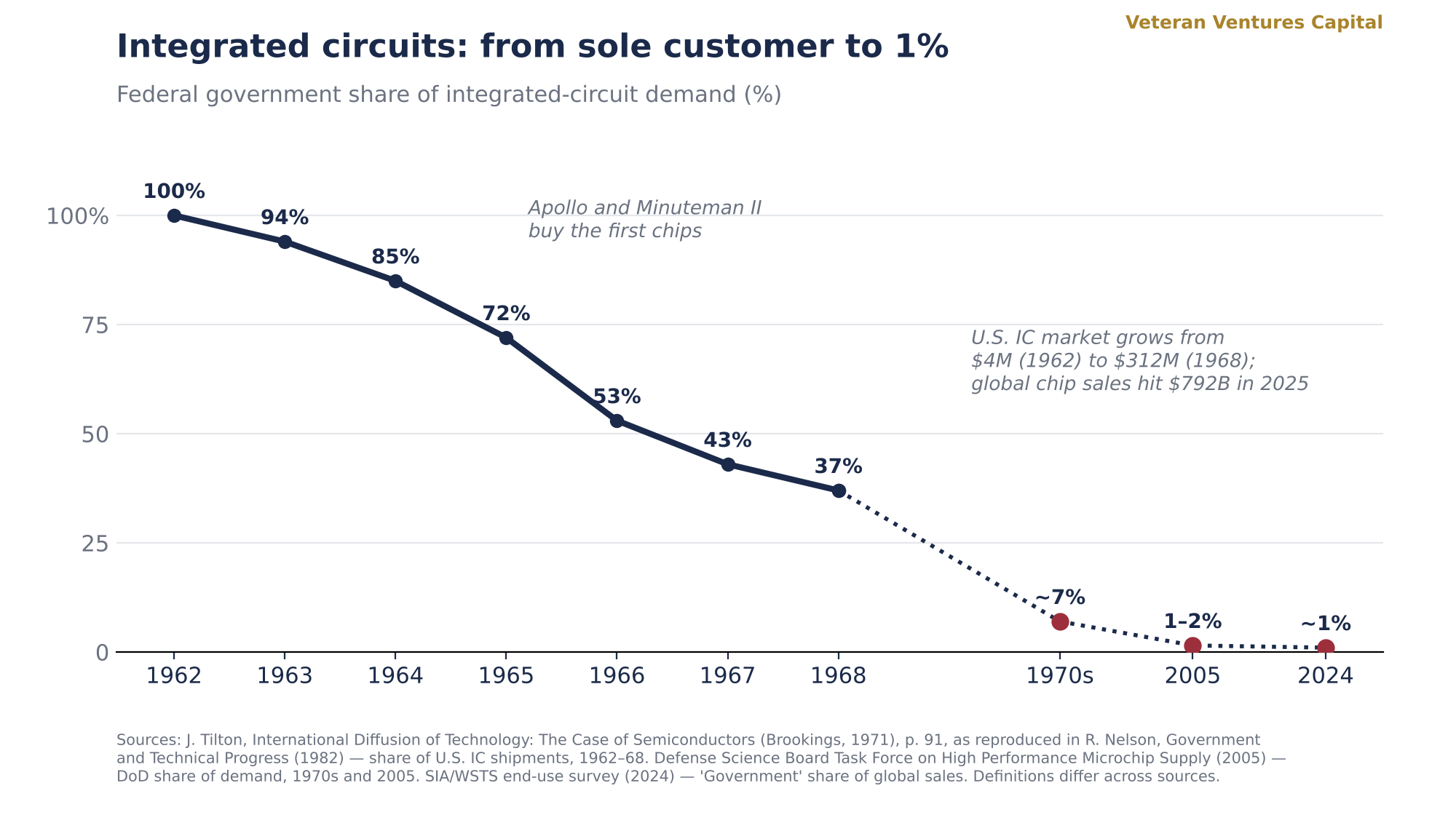
The trend never reversed. A 2005 Defense Science Board task force estimated that DoD accounted for 1 to 2 percent of semiconductor demand, down from about 7 percent in the 1970s.13 The industry's end-use survey now puts government at about 1 percent of global chip sales, and global sales reached $791.7 billion in 2025.14
The consequences are concrete. IBM ran DoD's only leading-edge trusted foundry until it sold those fabs to GlobalFoundries in 2015. The Government Accountability Office concluded that DoD had very little influence over the commercial market it now depended on.15 The department has since moved away from the trusted-foundry model toward assuring chips made in commercial fabs, and in 2024 the Commerce Department awarded Intel up to $3 billion in CHIPS Act funds to build a secure enclave for the Pentagon.16 When you are 1 percent of a market, you do not set its direction. You negotiate for access.
One caveat keeps this honest. Fairchild's early integrated-circuit work was privately funded, and Robert Noyce described the military as a stepping-stone to the commercial market rather than the destination.17 The government did not invent the semiconductor industry by itself. It was the first customer willing to pay for the learning curve, and that was enough.
2. Computing: Every Frontier Machine Had a Federal First Buyer
The first general-purpose electronic computer, ENIAC, was a wartime Army Ordnance project to compute artillery firing tables. In the "era of government computers" from 1945 to 1960, federal money made up roughly three-quarters of the entire computer field.18
The SAGE air-defense network turned IBM into a computer company. IBM built 56 of the system's enormous computers and earned more than $500 million on the program. By IBM's own account, SAGE produced about 80 percent of its computing revenue in the early 1950s.19 The software contractor for SAGE trained more than 10,000 people in computer systems by 1963, a university for programmers, as one historian later put it.20 The frontier stayed federal for decades. The first CDC 6600 supercomputers went to the weapons labs at Livermore and Los Alamos in 1965, and Cray-1 serial number 001 went to Los Alamos in 1976.21
Then the share fell. The economist Kenneth Flamm tracked federal funding as a share of computer-industry R&D: about 60 percent in the 1950s, 33 percent by the mid-1960s, 13 percent in 1980, 6 percent in 1990, and 0.4 percent by 1997.22
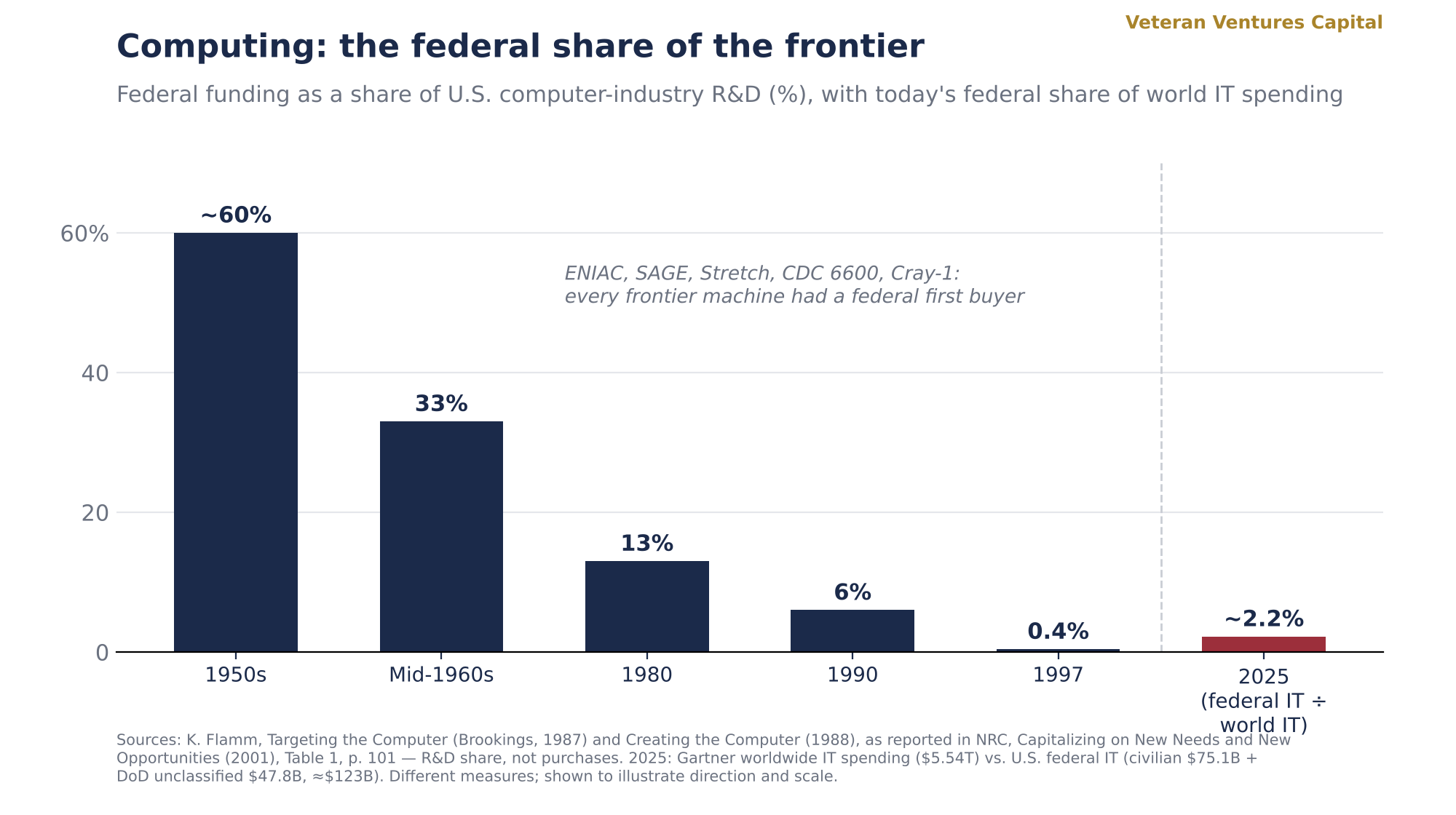
Today the gap is larger still. In 2025, Amazon, Microsoft, Alphabet, and Meta together spent about $415 billion on capital expenditure, much of it on data centers.23 The Department of Energy's Exascale Computing Project, the flagship federal supercomputing effort, cost about $1.8 billion over its whole eight-year life.24 All U.S. federal IT spending, civilian and unclassified defense combined, comes to about 2.2 percent of worldwide IT spending.25
Two caveats. First, commercial computers outsold government machines by unit count from early on; IBM's mid-1950s business machines sold by the thousand.26 The government's dominance was in the frontier and in R&D, not in the installed base. Second, the national labs still anchor the very top of the supercomputer rankings: U.S. Department of Energy machines held the second through fourth spots on the June 2026 TOP500 list.27 But the largest AI training clusters in the world now belong to private companies, and the commercial frontier is the one that sets the price of every chip the labs buy.
3. Space Launch and Satellites: From 99 Percent to 10
No market began more completely in government hands. Most early American launch vehicles were converted ballistic missiles: Thor, Atlas, and Titan. The first operational satellite program to return useful imagery, the CORONA reconnaissance system, flew in 1960 under a cover story, with film capsules caught in midair over the Pacific.28
The astrophysicist Jonathan McDowell, long of the Harvard-Smithsonian Center for Astrophysics, maintains one of the most complete public catalogs of objects ever launched. His data, sorted by owner, shows the arc as clearly as anything in this essay.29 In the 1960s, governments owned 99.4 percent of all satellites launched worldwide, and defense agencies alone owned about two-thirds. In the 1990s, the commercial share passed 24 percent for the first time. So far in the 2020s, commercial operators own 87.5 percent of everything launched, and defense owns about 5 percent.
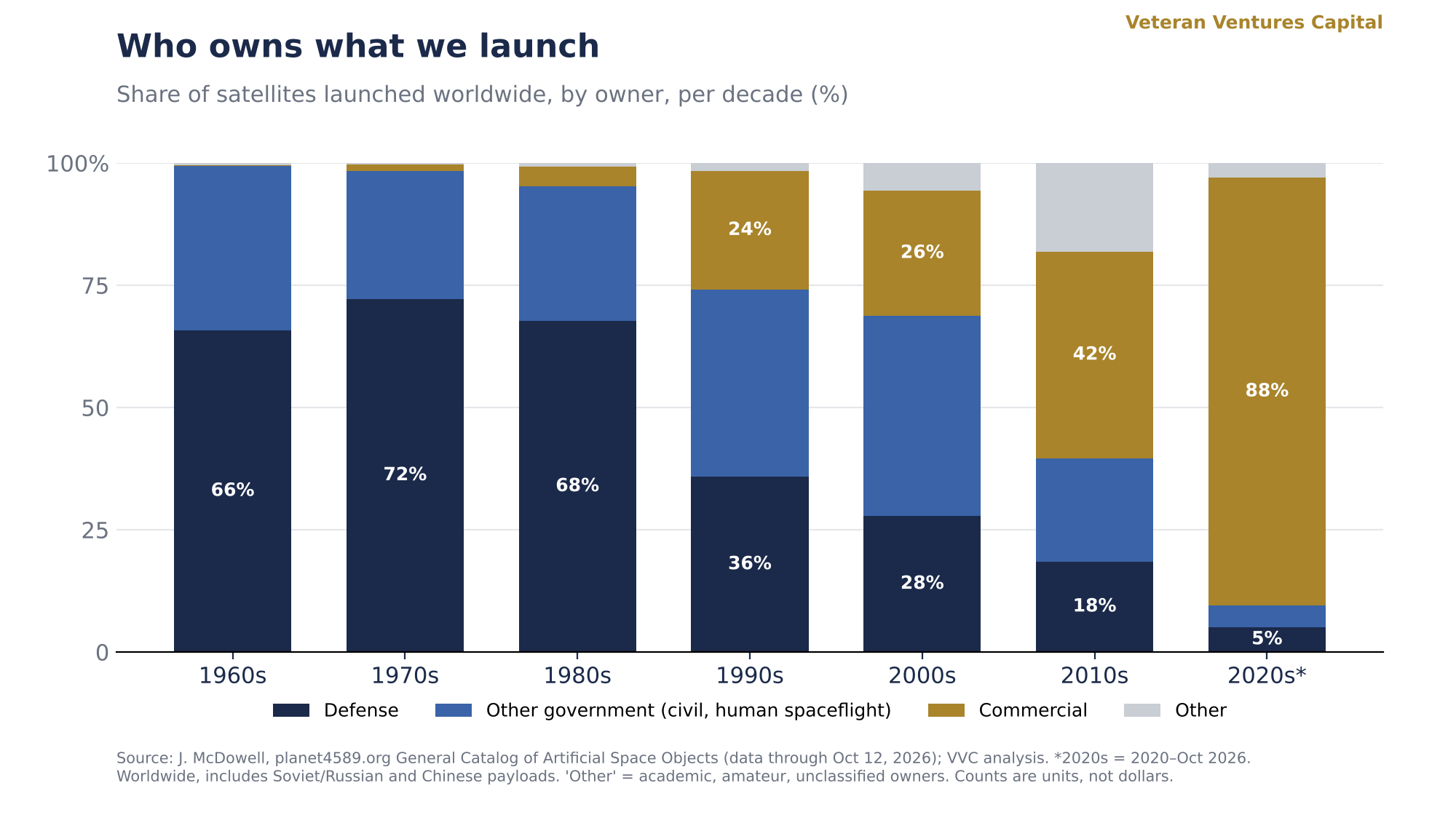
The driver is no mystery. In 2025, 4,524 payloads went to orbit, and satellites owned by SpaceX alone made up roughly 70 percent of them.30 As of this month, Starlink has more than 11,000 working satellites in orbit.31 By the Space Foundation's estimate, the global space economy reached $686 billion in 2025, and 79 percent of it was commercial.32
Here the caveats matter more than anywhere else in this essay. First, defense launches have not collapsed: 994 defense satellites so far this decade, nearly four times the 273 of the 2000s. The share fell because the number of commercial satellites launched grew about fourteenfold from the 2010s to this decade. Second, government money built the commercial champion. NASA paid SpaceX $396 million to help develop Falcon 9 and Dragon under its commercial cargo program.33 In April 2025, the Space Force awarded SpaceX $5.9 billion for 28 national security launches,34 and SpaceX's IPO filing shows that about a fifth of its 2025 revenue came from federal agencies.35 Third, counting satellites understates the government's share of dollars, since a single exquisite national security satellite can cost as much as hundreds of Starlinks.
The honest summary: the government was the smart anchor customer, not the market. It paid for the first launches and still pays reliably. But the launch rate, the cost curve, and the manufacturing lines are now set by a commercial broadband constellation. That is exactly why the cost to reach orbit has fallen for everyone, including the Pentagon.
4. Carbon Fiber: From Rocket Nozzles to Wind Turbines
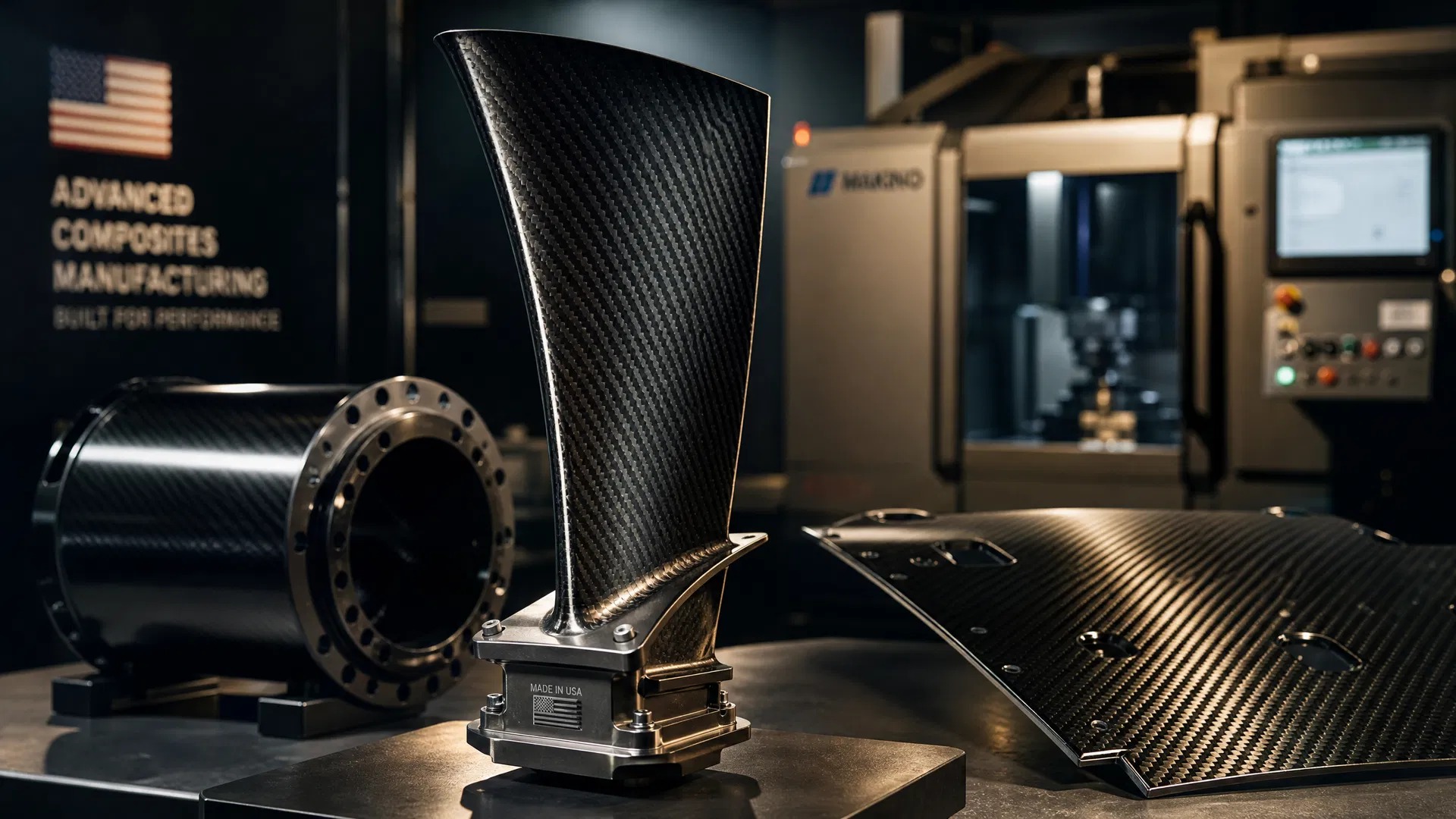
In 1958, a young physicist named Roger Bacon was trying to measure the triple point of carbon in an arc furnace at Union Carbide's Parma laboratory, outside Cleveland. Near the electrode he found strange whiskers of graphite, about ten times stronger than the best steel. He estimated they cost $10 million a pound to make.36 That same year, Union Carbide offered carbonized cloth to the Air Force, which needed something better than fiberglass for rocket nozzles and reentry heat shields.37 The process that made carbon fiber cheap came from government laboratories as well: Britain's Royal Aircraft Establishment developed the PAN-based route in 1963, in parallel with a 1959 Japanese government patent.38
For two decades DoD drove the industry. The National Research Council described the department as the engine of the industry's double-digit growth from 1969 to 1989. Then DoD consumption peaked and fell. By 1997, DoD used about 5 percent of the world's carbon fiber. By 2003, the figure was about 4 percent.39
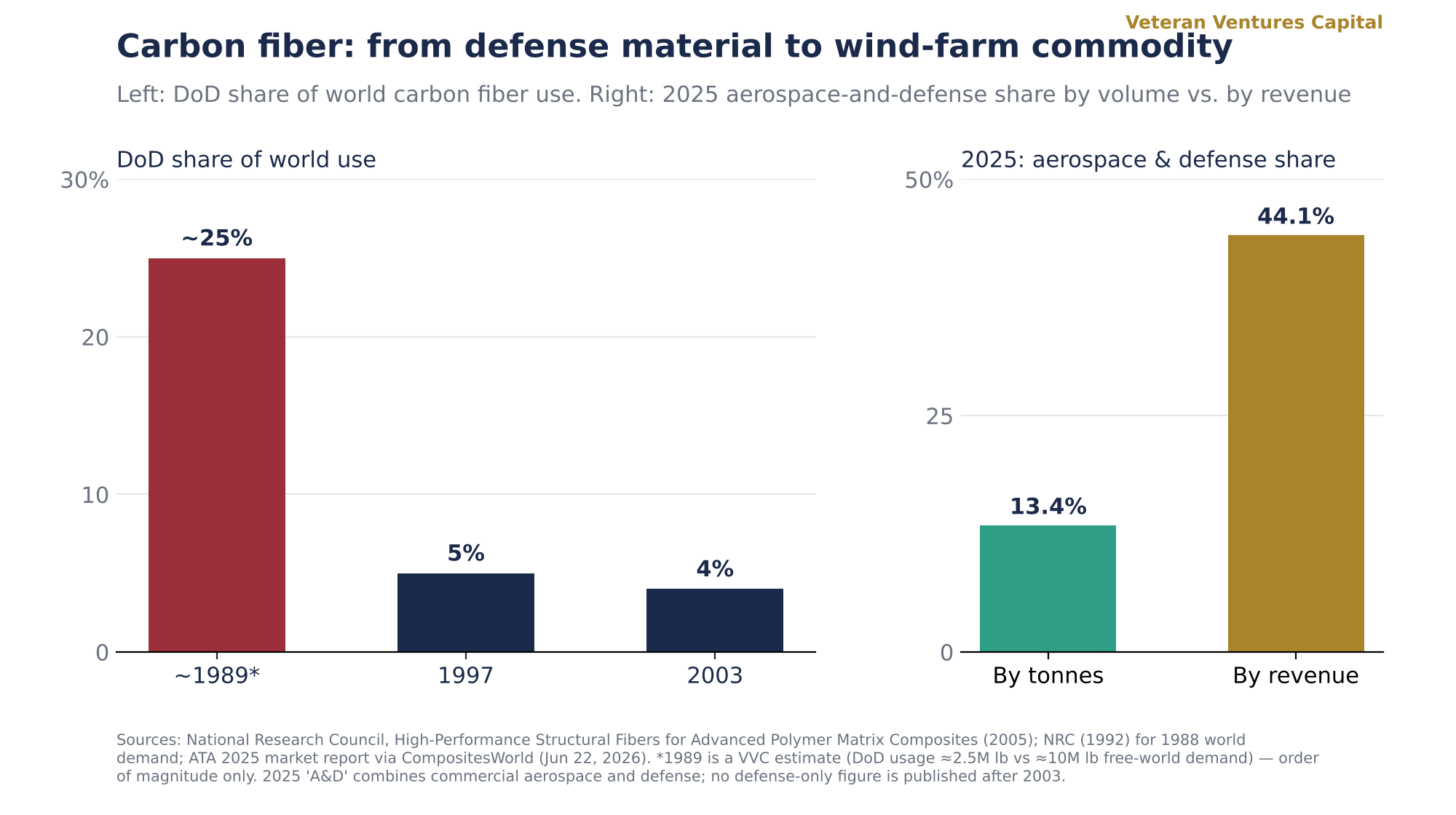
By tonnage, today's market belongs to wind energy. In 2025, wind turbine blades took about 44.5 percent of global carbon fiber demand, while aerospace and defense together took about 13.4 percent.40 Most of that 13.4 percent is commercial aircraft, not the Pentagon.
This sector is the most complicated case in the essay, and we would be doing readers a disservice to flatten it. Aerospace fiber sells for roughly $80 a kilogram, against about $12 for wind-grade fiber, so aerospace and defense still account for about 44 percent of carbon fiber revenue.40 Worse, the private demand that now dominates the market is increasingly met by Chinese capacity. China passed 50 percent of global production capacity in 2025, while Western producers including Teijin and SGL scaled back U.S. operations.40 Even the market's size is contested: the two leading sources disagree by about 60 percent on 2025 demand.41
The lesson of carbon fiber is that private demand sustains an industrial base, but not necessarily our industrial base. A dual-use strategy works only if the commercial volume flows through American factories.
5. Artificial Intelligence: The Buyer That Started It Is Now a Rounding Error
The leading university AI labs of the 1960s were built with Pentagon money. ARPA's Information Processing Techniques Office, founded in 1962, funded the centers at MIT, Carnegie Mellon, Stanford, and SRI. In the National Research Council's assessment, it transformed AI from small projects into a large research enterprise.42
Speech recognition is a clean example. In 1971, ARPA launched a five-year, roughly $15 million Speech Understanding Research program. Carnegie Mellon's Harpy system came closest to the goals, reaching about 95 percent accuracy on a 1,000-word vocabulary, though it needed far more computing time than real speech allowed.43 ARPA ended the program in 1976. The work did not die: two CMU researchers from that era, James and Janet Baker, founded Dragon Systems, the root of the dictation software many professionals still use.42 As late as 1984, DARPA alone supplied roughly three-quarters of all federal AI funding.42
Then came the program that most directly reached consumers. In 2003, DARPA's Personalized Assistant that Learns program funded SRI's CALO project, a five-year, $150 million effort involving more than 300 researchers.44 A spinout from that work became Siri. Apple bought it in April 2010.45
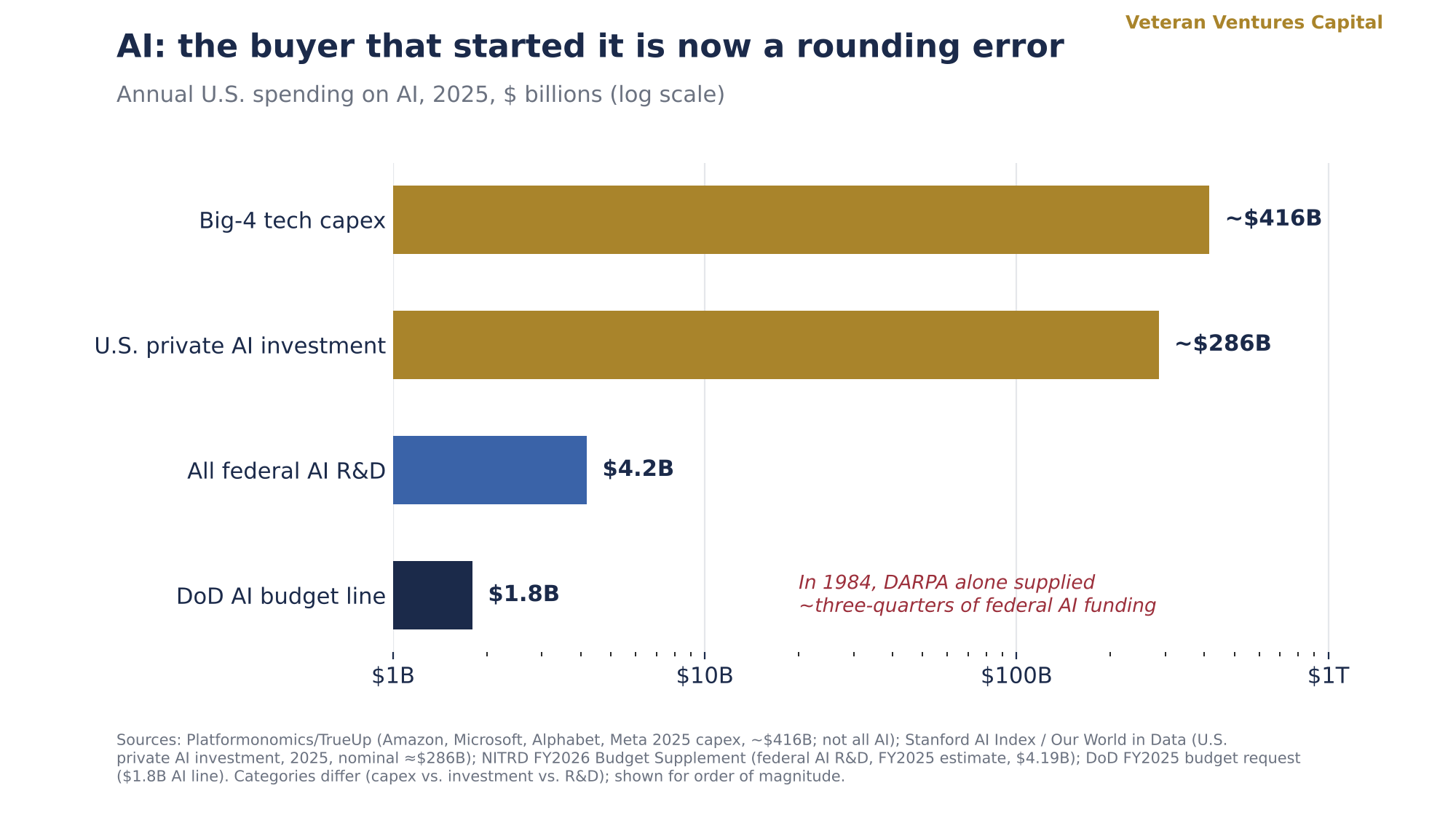
The scale today is barely comparable. U.S. private investment in AI was roughly $286 billion in 2025, by the Stanford AI Index's count, and four of the largest U.S. tech companies spent about $416 billion on capital expenditure.46,23 Total federal AI R&D across every reporting agency was estimated at about $4.2 billion for fiscal 2025, and DoD's dedicated AI budget line was about $1.8 billion.47,48 On these numbers, the Pentagon accounts for well under 1 percent of American AI spending. It now buys frontier models as a tenant of systems financed by advertising, cloud, and consumer subscriptions.
A fair caveat: within the federal government, DoD still dominates. Brookings found that defense agencies held about 95 percent of the potential value of federal AI contracts.49 DoD remains the biggest public buyer. It is simply a small one in the market that matters.
6. Mobile Robots: From Shakey to the Factory Floor
In 1966, researchers at the Stanford Research Institute began building a robot so unsteady on its wheels that, as one of them put it, it shook, so they named it Shakey. The project was funded by ARPA through the Air Force's Rome Air Development Center. Over six years, Shakey's team produced the A* search algorithm (1968), the STRIPS planner (1971), and an early practical use of the Hough transform for machine vision (1972).50 Those are still among the basic tools of robot navigation.
The Pentagon kept pushing. In 2004, DARPA offered $1 million to any vehicle that could drive itself across the Mojave Desert. No vehicle finished, and the best made it only 7.5 miles. A year later, five vehicles completed the 132-mile course, and Stanford's "Stanley" took the $2 million prize.51 The engineers from those teams went on to found or lead much of the autonomous-vehicle industry.
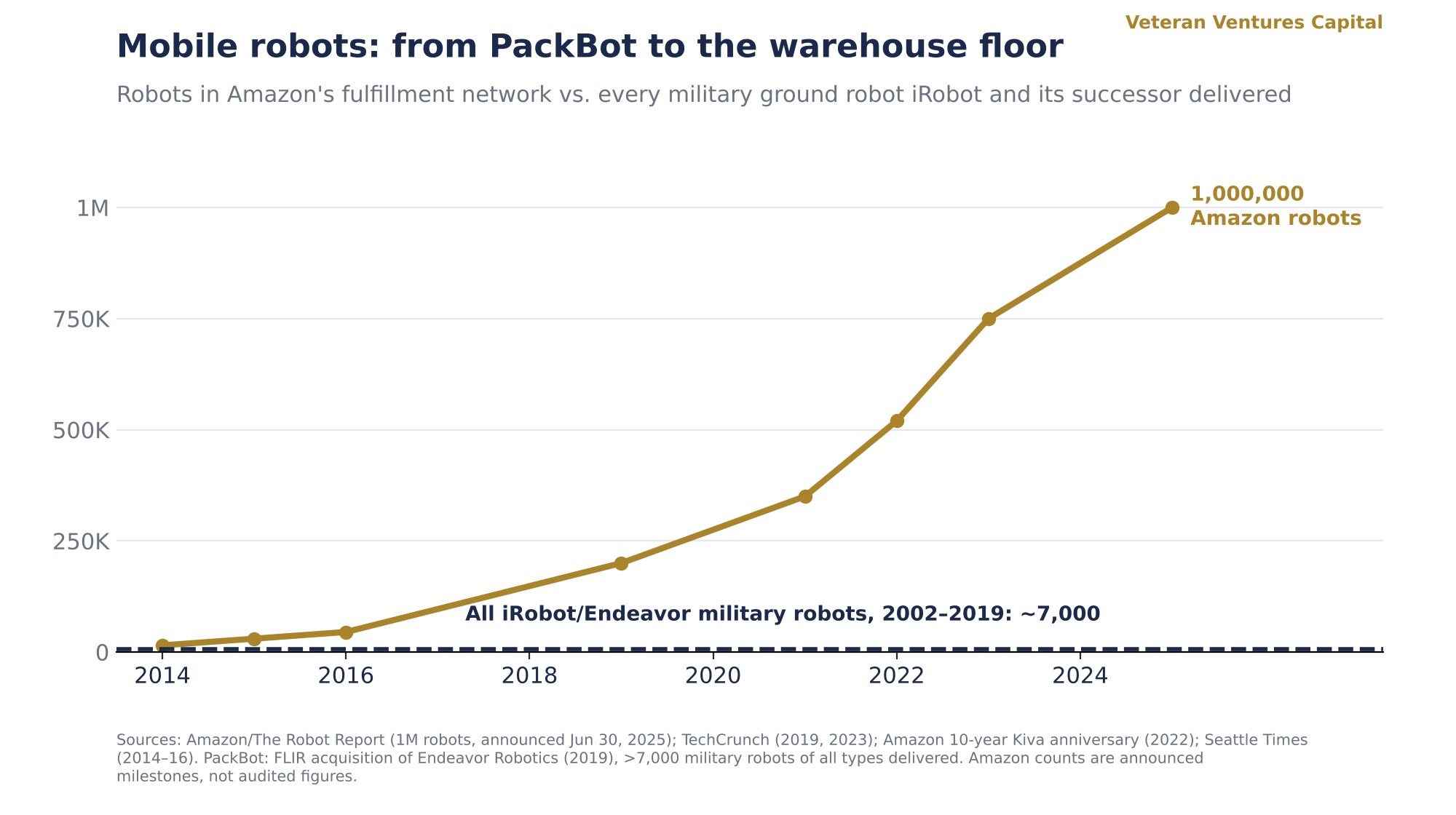
In the field, military ground robots arrived through iRobot's PackBot, which grew out of a 1998 DARPA contract and was used to search the rubble of the World Trade Center before deploying to Afghanistan. Over roughly seventeen years, iRobot's defense unit and its successor delivered about 7,000 military ground robots of all types. When iRobot sold that unit in 2016, it did so to concentrate on its much larger home business. Led by the Roomba, iRobot has sold more than 50 million robots.52,53
The warehouse robot story did not start in the defense market at all. Kiva Systems was founded in 2003 to move shelves to warehouse workers, and Amazon bought it in 2012 for $775 million.54 At the end of June 2025, Amazon announced its one-millionth robot.55 Worldwide, about 103,000 transport and logistics robots were sold in 2024 alone, according to the International Federation of Robotics, roughly fifteen times that entire military production run, in a single year.56 Analysts disagree on the size of the mobile-robot market, but most estimates for autonomous mobile and guided vehicles land between $2 billion and $5 billion today, growing at 15 to 19 percent a year.57
This is the sector where the pattern is newest, and therefore where the opportunity is largest. The intellectual foundations were funded by DARPA. The market was proven in e-commerce warehouses. The next frontier is the factory floor, including the factories that build trucks, munitions, ships, and aircraft.
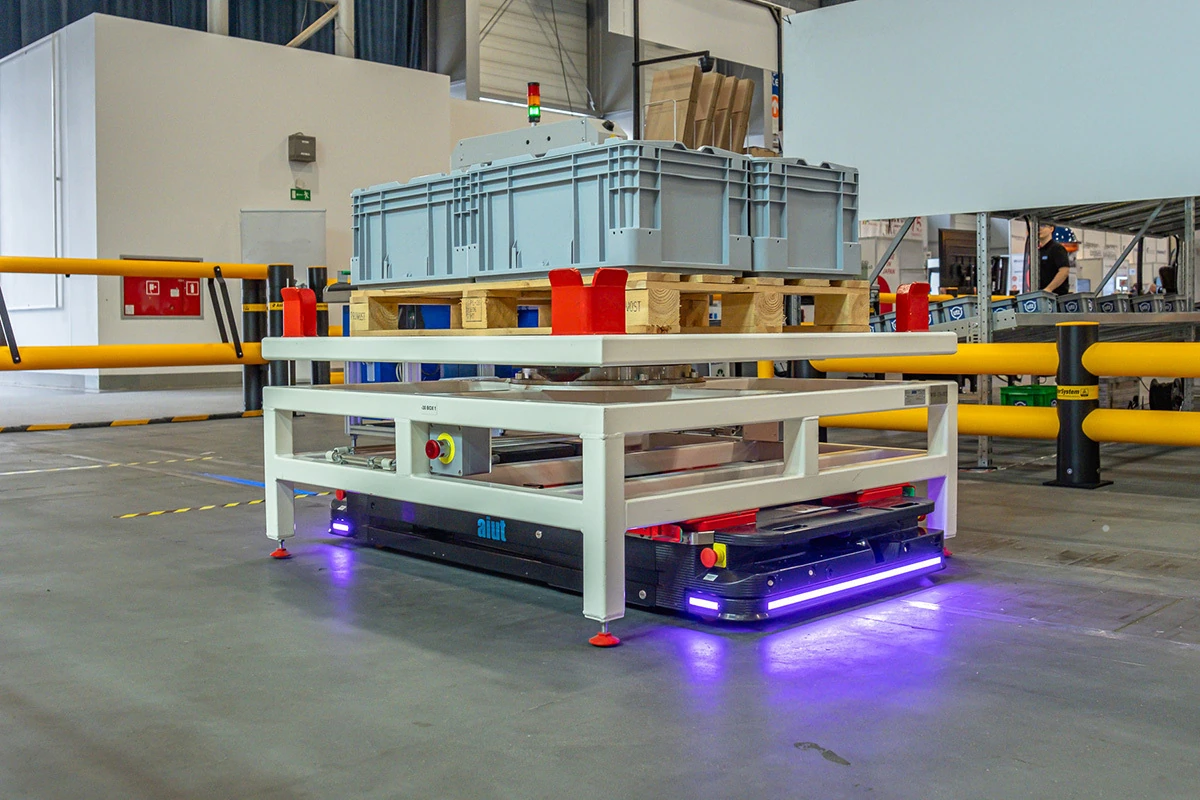
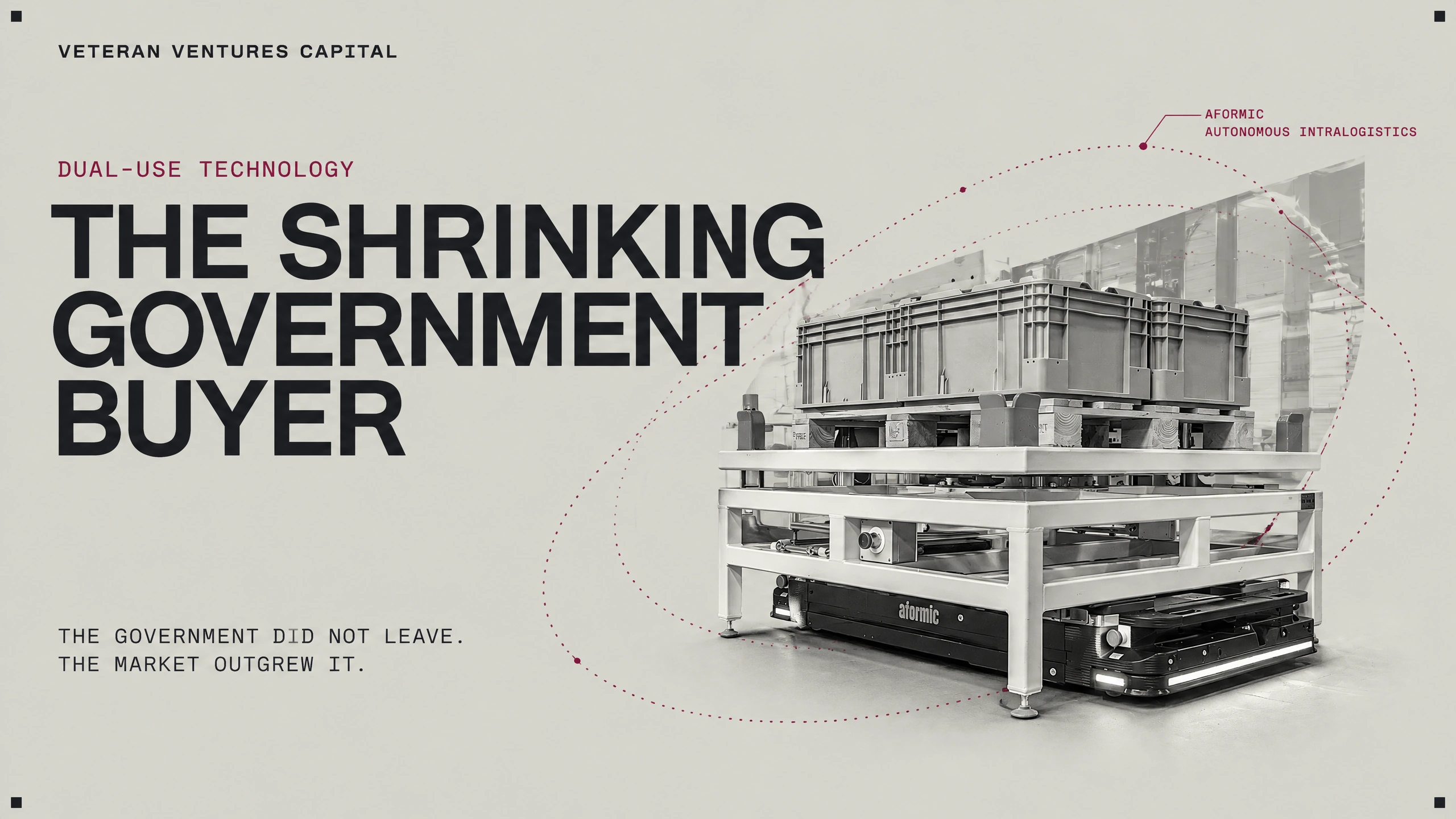
That is why Veteran Ventures Capital invested in Aformic. The company builds autonomous mobile robots and autonomous forklifts, and it develops the fleet-management software and factory data layer that coordinates them.58 Its low-profile F12 robot carries up to 800 kilograms at 1.5 meters per second.59 Aformic's published list of customers and partners runs from Toyota, Hyundai, Hitachi, Whirlpool, 3M, and First Solar to Oshkosh Defense, and the company reports hundreds of robots in service worldwide and more than $30 million in purchase orders to date.58
That list is the thesis in miniature: one product line and one software stack, built for appliance plants, solar factories, and defense vehicle lines alike. Commercial volume pays for the engineering and drives the cost down. The defense customer gets a mature, cheaper, and continuously improving product that no defense-only program could have afforded to build. Aformic does not need the Pentagon to be its biggest customer. It needs the Pentagon to be a good one.
The Scorecard
Set side by side, the six sectors tell one story with different endings. In each, the government paid for the hardest and least certain stage: the first units, at prices no commercial buyer would accept. In each, that spending started a learning curve that commercial demand then rode far past anything a defense budget could sustain. The table compresses the evidence. The measures differ from row to row, so read across each row rather than down the columns.
Sector | Government's role at birth | Government share, then | Government share, now | Who sets the pace today |
|---|---|---|---|---|
Semiconductors | Apollo and Minuteman II as first buyers | ~100% of U.S. IC purchases (1962, est.) | ~1% of global chip sales | Phones, PCs, data centers, cars |
Computing | ENIAC, SAGE, weapons-lab supercomputers | ~60% of computer-industry R&D (1950s) | ~2% of world IT spending (all federal) | Hyperscale cloud and AI |
Launch and satellites | ICBM-derived boosters, CORONA | 99% of satellites launched (1960s, all governments) | ~10% (2020s to date) | Broadband constellations |
Carbon fiber | Air Force nozzles and heat shields | roughly a quarter of world use (c. 1989, VVC est.) | ~4% (2003, last published) | Wind, pressure vessels, airliners |
Artificial intelligence | ARPA labs, speech research, CALO | DARPA ≈ 3/4 of federal AI funding (1984) | well under 1% of U.S. AI spending | Cloud, consumer, enterprise software |
Mobile robots | Shakey, Grand Challenges, PackBot | ~7,000 military robots over ~17 years | ~103,000 logistics robots sold in 2024 alone | E-commerce and manufacturing |
The one entry that resists the pattern is the most instructive. In carbon fiber, private demand won, but much of it went overseas. Losing majority-customer status is not the risk. The risk is losing it without a domestic commercial base ready to take over.
Where the Monopsony Survives, and Why We Don't Invest There
The pattern is not universal, and we would be wrong to pretend otherwise. In some markets, DoD remains the only buyer.
Solid rocket motors are the starkest example. The number of major U.S. producers fell from six in the mid-1990s to two, and the department has acknowledged that its demand can sustain only about two suppliers.60,61 The Pentagon's own 2022 review of competition found that the number of prime contractors had fallen from 51 to 5 since the 1990s, and tactical missile suppliers from 13 to 3.60 Nuclear submarines come from two shipyards.62 Strategic radiation-hardened chips come largely from Sandia's own fab, and in 2026 the department made a $16 million Defense Production Act award to BAE Systems simply to keep its radiation-hardened chip design line available.62 The most advanced night-vision image-intensifier tubes come from a very small number of qualified producers.63
These are not unimportant markets. Many are among the most critical in the entire defense enterprise, and new venture-backed entrants in rocket motors are a welcome development.64 But look at what they share: consolidation to one or two suppliers, single points of failure, and recurring rescue funding from the government. That is what happens to an industrial base when its only customer is one budget line.
For a venture investor, those features are disqualifying, and we want to be direct about why. A government-only market caps the addressable market at a single customer's appropriation. It ties revenue to one budget cycle and one requirements process. It limits exits to a handful of prime contractors. Our screen at VVC asks whether a company's production line can serve both a national-security buyer and a commercial one. A company that can only ever sell to DoD fails that screen, however important its product is. The country needs those companies. It needs a different kind of capital to build them.
The Dual-Use Dividend
Go back to the empty Pentagon halls in 1973. Parkinson's team built a military system. Its greatest military payoff came after the government let civilians in. The Army that went to the Gulf in 1991 could navigate the desert partly because a commercial receiver industry already existed. The Pentagon got cheaper, better, and more plentiful GPS because it had stopped being the only customer.
That is the lesson of all six sectors, and it is the core of how VVC invests. Defense technology does not thrive by being protected from the commercial market. It thrives by being pulled forward by it. Demand is funded; capacity is not. The Pentagon's budget can fund demand. Only commercial volume can fund the factories, the supply chains, and the learning curves that turn a promising prototype into a production line.
For founders, this means designing from the first day for two customers: the one that validates you and the one that scales you. For limited partners, it means the defense opportunity is larger than the defense budget, because the companies that win are the ones the commercial market pays to improve. For the Department of Defense, it means accepting a role it has been playing for decades without quite admitting it. In most of the technologies that will decide future wars, it is a minority customer. The smart move is to be the best minority customer in the room: fast, predictable, and willing to buy what the commercial market has already made excellent.
The Pentagon paid for the first chapter of these markets. It does not need to own them. It needs to be able to buy from them.
Endnotes
1. Jonathan Coopersmith, "The Father of GPS" (Q&A with Bradford Parkinson), Aerospace America (AIAA), July 1, 2025, https://aerospaceamerica.aiaa.org/features/the-father-of-gps/. Covers Parkinson's AC-130 fire-control work, the 26 combat missions, the failed August 1973 DSARC briefing, and the Labor Day 1973 redesign. See also "Bradford Parkinson," Wikipedia (combat service from Ubon, Thailand).
2. On the competing claims for credit: Richard Easton, review of the GPS documentary, The Space Review, November 5, 2018, https://thespacereview.com/article/3596/1. Easton, son of NRL's Roger Easton, argues that key elements came from the Navy's Timation program.
3. Air Force Historical Foundation, "February 22, 1978," https://afhistory.org/february-22-1978-3/ (launch of NAVSTAR 1 on an Atlas F from Vandenberg).
4. Peter Grier, "The Death of Korean Air Lines Flight 007," Air & Space Forces Magazine, January 1, 2013, https://www.airandspaceforces.com/article/0113korean/; Ronald Reagan Presidential Library, "Statement by Deputy Press Secretary Speakes on the Soviet Attack on a Korean Civilian Airliner," September 16, 1983, https://www.reaganlibrary.gov/research/speeches/91683c.
5. Kaleb Dissinger, "GPS Goes to War: The Global Positioning System in Operation Desert Storm," Army.mil, February 14, 2008, https://www.army.mil/article/7457/gps_goes_to_war_the_global_positioning_system_in_operation_desert_storm. On soldiers' families mailing civilian receivers: Isobel Porteous and Matt Kaplan, "GPS and the Limits of Control," Lawfare, September 9, 2026, https://www.lawfaremedia.org/article/gps-and-the-limits-of-control.
6. William J. Clinton, "Statement on the Decision To Stop Degrading Global Positioning System Signals," May 1, 2000, American Presidency Project, https://www.presidency.ucsb.edu/documents/statement-the-decision-stop-degrading-global-positioning-system-signals.
7. European GNSS Agency, "GSA releases 6th GNSS Market Report," October 15, 2019, https://www.euspa.europa.eu/newsroom-events/news-archive/european-gnss-agency-gsa-releases-6th-gnss-market-report (6.4 billion installed devices); Shephard Media, "Rockwell Collins delivers 400,000th DAGR," November 4, 2010.
8. NIST, "Economic Benefits of the Global Positioning System to the U.S. Private Sector Study" (RTI International), October 2, 2019, https://www.nist.gov/news-events/news/2019/10/economic-benefits-global-positioning-system-us-private-sector-study. Benefits in 2017 dollars, 1984–2017.
9. GPS.gov, "Fiscal Year 2023 Program Funding," https://gps.gov/policy/funding/2023 (about $1.84B requested, covering space, control, and military user segments).
10. Computer History Museum, "1962: Aerospace systems are the first applications for ICs in computers," The Silicon Engine, https://www.computerhistory.org/siliconengine/aerospace-systems-are-first-the-applications-for-ics-in-computers/. Early chip prices: Paul E. Ceruzzi, A History of Modern Computing, 2nd ed. (MIT Press, 2003), pp. 188–89.
11. "The Integrated Circuit Industry," Electronics World, November 1965 (reproduced by RF Cafe), https://www.rfcafe.com/references/electronics-world/integrated-circuit-industry-electronics-world-november-1965.htm; Computer History Museum, "Minuteman II Missile ICs, TI, 1964," catalog 102711695. Denominator: Electronics World puts the 1965 market at about $60M; Tilton (1971) at about $79M. Hence "a fifth to a quarter."
12. John E. Tilton, International Diffusion of Technology: The Case of Semiconductors (Brookings Institution, 1971), p. 91, as reproduced in Richard R. Nelson, ed., Government and Technical Progress (Pergamon, 1982), p. 63; see also Anna Slomovic, Anteing Up: The Government's Changing Role in the Microelectronics Industry, RAND P-7516-RGS, 1988, https://apps.dtic.mil/sti/pdfs/ADA228267.pdf. Tilton's 1962–64 figures are estimates.
13. Defense Science Board, Report of the DSB Task Force on High Performance Microchip Supply, February 2005, pp. 17, 33, https://apps.dtic.mil/sti/pdfs/ADA435563.pdf.
14. Semiconductor Industry Association, "Global Annual Semiconductor Sales Increase 25.6% to $791.7 Billion in 2025," February 6, 2026, https://www.semiconductors.org/global-annual-semiconductor-sales-increase-25-6-to-791-7-billion-in-2025/; SIA, "Semiconductor Demand Drivers Increase Across the Board in 2018" (WSTS end-use survey), March 22, 2019; SIA, 2025 Factbook (2024 end-use shares).
15. U.S. GAO, Trusted Defense Microelectronics: Future Access and Capabilities Are Uncertain, GAO-16-185T, October 28, 2015, https://www.gao.gov/products/GAO-16-185T.
16. DoD Inspector General, Evaluation of the DoD's Transition From a Trusted Foundry Model to a Quantifiable Assurance Method, DODIG-2022-084, May 2, 2022; "What we can gauge from Intel's $3B military chip grant," Washington Technology, September 17, 2024 (CHIPS Act award by the Department of Commerce for DoD's Secure Enclave program).
17. Robert N. Noyce, oral history, IEEE History Center / ETHW, https://ethw.org/Oral-History:Robert_N._Noyce; Slomovic (1988), op. cit.
18. National Research Council, Funding a Revolution: Government Support for Computing Research (National Academies Press, 1999), ch. 4, https://www.nationalacademies.org/read/6323/chapter/6.
19. IBM, "SAGE: The first national air defense network," IBM History, https://www.ibm.com/history/sage. Revenue figure: NRC, Funding a Revolution (1999), p. 94.
20. NRC, Funding a Revolution (1999), p. 96, citing Claude Baum, The System Builders (1981). "University for programmers": Martin Campbell-Kelly, From Airline Reservations to Sonic the Hedgehog (MIT Press, 2003).
21. "CDC 6600," Wikipedia, citing N. Lewis, IEEE Annals of the History of Computing; Computer History Museum, "CDC 6600's Five Year Reign," Revolution, https://www.computerhistory.org/revolution/supercomputers/10/33; on Cray-1 serial 001, NCAR Supercomputer Gallery as cited in "Cray-1," Wikipedia.
22. Kenneth Flamm, in National Research Council, Capitalizing on New Needs and New Opportunities (NAP, 2001), Panel II, Table 1, p. 101, https://www.nationalacademies.org/read/10281/chapter/12; see also Flamm, Creating the Computer (Brookings, 1988). The series measures R&D funding, not purchases.
23. Charles Fitzgerald, "Follow the CAPEX: 2025 Retrospective," Platformonomics, February 25, 2026, https://platformonomics.com/?p=34926. Combined 2025 capex of Amazon, Microsoft, Alphabet, and Meta, about $416B; capex covers all purposes, not only AI.
24. DOE Exascale Computing Project, "ECP Overview," ASCAC meeting, May 2024 (total project cost $1,812.3M), https://science.osti.gov/-/media/ascr/ascac/pdf/meetings/2024/ECP-OverviewASCACMay2024pptx.pdf.
25. Gartner, "Gartner Forecasts Worldwide IT Spending to Grow 9.8% in 2026," October 22, 2025 ($5.54T in 2025); Congressional Research Service, R48049, April 24, 2024 (federal civilian IT, $75.1B, FY2025 request); DoD CIO/CAPE, FY2025 IT/Cyberspace Activities Budget Overview ($47.8B). Ratio is VVC's calculation; excludes classified IT; fiscal and calendar years differ.
26. Thomas Haigh, SIGCIS discussion of early computer installations, September 14, 2010, https://lists.sigcis.org/archives/list/members@lists.sigcis.org/thread/ZUSA443IM4FFYYGNEM263MHIRWHCH5X3/; NRC (1999), op. cit.
27. TOP500, June 2026 list, https://top500.org/lists/2026/06.
28. National Reconnaissance Office, "CORONA: America's Eyes in Space," https://www.nro.gov/About-NRO/history/history-corona/.
29. Jonathan McDowell, "Satellites launched by owner class and decade," Jonathan's Space Pages, data updated October 12, 2026, https://www.planet4589.org/space/stats/out/satpie.txt. Percentages are VVC calculations from McDowell's counts. Worldwide data, including Soviet/Russian payloads.
30. Jonathan McDowell, Space Activities in 2025, Rev. 1.4, February 4, 2026, https://planet4589.org/space/papers/space25.1.4.pdf; McDowell, "Satellites per year by country, plus SpaceX," https://www.planet4589.org/space/stats/out/econ.txt.
31. Jonathan McDowell, "Starlink Statistics," accessed October 24, 2026, https://planet4589.org/space/con/star/stats.html.
32. Space Foundation, The State of the Global Space Economy: 2026, July 2026, https://www.spacefoundation.org/wp-content/uploads/2026/07/SF-GSE-REPORT-2026July-FOR-RELEASE.pdf. Note that the commercial share was already about 76% in 2014; this measure is dominated by downstream services.
33. NASA Commercial Orbital Transportation Services (COTS) funding to SpaceX, as summarized in "Commercial Orbital Transportation Services," Wikipedia, citing NASA program documents.
34. U.S. Space Force, "Space Systems Command awards National Security Space Launch Phase 3 Lane 2 contracts," April 4, 2025, https://www.spaceforce.mil/News/Article-Display/Article/4146459/.
35. Ross Wilkers, "SpaceX's S-1 lays out its government work and market ambitions," Washington Technology, May 20, 2026, https://washingtontechnology.com/companies/2026/05/spacexs-s-1-lays-out-its-government-work-and-market-ambitions/413681/. The federal share is diluted by xAI and X revenue consolidated into the filing.
36. Steve Brachmann, "Evolution of Tech: Roger Bacon's high-performance carbon fibers," IPWatchdog, October 24, 2016, https://ipwatchdog.com/2016/10/24/roger-bacons-high-performance-carbon-fibers/; "Roger Bacon (physicist)," Wikipedia.
37. NASAMPE, "Carbon Fiber" (history), https://www.nasampe.org/page/CarbonFiber.
38. WIPO, "PAN Carbon Fiber: How One Patent Launched a Global Industry," IP Advantage, https://www.wipo.int/en/web/ip-advantage/w/stories/pan-carbon-fiber; Science Museum Group, "William Watt," https://collection.sciencemuseumgroup.org.uk/people/cp173041. WIPO describes the British and Japanese work as parallel breakthroughs.
39. National Research Council, High-Performance Structural Fibers for Advanced Polymer Matrix Composites (NAP, 2005), ch. 3, https://www.nationalacademies.org/read/11268/chapter/5. The c. 1989 figure in Chart 4 is VVC's order-of-magnitude estimate combining NRC (2005) DoD usage with NRC (1992) free-world demand.
40. "ATA 2025 global carbon fiber composites market report documents record demand," CompositesWorld, June 22, 2026, https://www.compositesworld.com/news/ata-2025-global-carbon-fiber-composites-market-report-documents-record-demand. "Aerospace and defense" combines commercial aerospace and defense. On Western retrenchment (Teijin, SGL): CompositesWorld, June 2026.
41. Toray Industries, "Carbon Fiber Composite Materials Business — IR Day," June 9, 2026, https://www.toray.com/ir/pdf/lib/lib_a564.pdf (Toray estimates 2025 demand at about 138,000 t versus ATA's 224,510 t).
42. National Research Council, Funding a Revolution (1999), ch. 9, "Developments in Artificial Intelligence," https://www.nationalacademies.org/read/6323/chapter/11. The 1984 DARPA share (~$77.6M of ~$105.6M) is VVC's calculation from the NRC's tables.
43. Dennis H. Klatt, "Review of the ARPA Speech Understanding Project," Journal of the Acoustical Society of America (1977).
44. SRI International, "Artificial Intelligence: CALO," SRI Hall of Innovation, https://sri.com/hoi/artificial-intelligence-calo.
45. "Confirmed: Apple Buys Virtual Personal Assistant Startup Siri," TechCrunch, April 28, 2010, https://techcrunch.com/2010/04/28/apple-buys-virtual-personal-assistant-startup-siri/; Wade Roush, "The Story of Siri," Xconomy, June 14, 2010.
46. Stanford HAI, AI Index Report 2026, "Economy," April 2026, https://hai.stanford.edu/ai-index/2026-ai-index-report/economy; Our World in Data, "Private investment in artificial intelligence," https://ourworldindata.org/grapher/private-investment-in-artificial-intelligence.
47. NITRD, FY2026 NITRD Budget Supplement (2025), https://www.nitrd.gov/pubs/FY26-NITRD-Budget-Supplement.pdf ($4.19B FY2025 estimate across reporting agencies). The $4.19B figure is VVC's sum of the supplement's agency tables.
48. Brandi Vincent, "Pentagon's AI budget request for 2025 stays flat at $1.8B," DefenseScoop, March 11, 2024, https://defensescoop.com/2024/03/11/pentagon-ai-budget-request-2025/. DoD's FY2026 "AI and autonomy" request of $13.4B is mostly autonomous platforms and is not comparable.
49. Larson, Denford, Dawson, and Desouza, "The evolution of artificial intelligence (AI) spending by the U.S. government," Brookings, March 26, 2024, https://www.brookings.edu/articles/the-evolution-of-artificial-intelligence-ai-spending-by-the-u-s-government.
50. Nils J. Nilsson, ed., Shakey the Robot, SRI AI Center Technical Note 323, April 1984, https://ai.stanford.edu/~nilsson/OnlinePubs-Nils/shakey-the-robot.pdf; Computer History Museum, "Shakey," Revolution; DARPA, "Shakey the Robot," Innovation Timeline.
51. DARPA, "The DARPA Grand Challenge: Ten Years Later," March 13, 2014, https://www.darpa.mil/news/2014/grand-challenge-ten-years-later.
52. iRobot Corp., Form 8-K Exhibit 99.1, "iRobot to Sell Defense & Security Business to Arlington Capital Partners," February 4, 2016; FLIR Systems, Form 8-K Exhibit 99.1 (acquisition of Endeavor Robotics), February 11, 2019 (more than 7,000 units delivered).
53. iRobot, "Our Story," https://www.irobot.com/en_US/our-story.html.
54. Amazon.com, Form 8-K Exhibit 99.1, "Amazon.com to Acquire Kiva Systems," March 19, 2012, https://www.sec.gov/Archives/edgar/data/0001018724/000119312512122135/d318297dex991.htm.
55. "Amazon launches new AI foundation model, deploys 1 millionth robot," The Robot Report, July 1, 2025 (announced June 30, 2025), https://www.therobotreport.com/amazon-launches-new-ai-foundation-model-deploys-1-millionth-robot/. Earlier counts in Chart 6: Seattle Times via Industrial Distribution (2017); TechCrunch (June 5, 2019; October 18, 2023); Amazon 10-year Kiva anniversary (June 2022).
56. International Federation of Robotics, "Service robots see global growth boom," October 7, 2025, https://ifr.org/ifr-press-releases/news/service-robots-see-global-growth-boom.
57. Interact Analysis via Robotics 24/7, "Mobile robots market outpaces fixed automation with 19% annual growth to 2030," January 15, 2026; MarketsandMarkets, GMI, IMARC, and Polaris AMR market reports (2024–2025). Estimates vary widely with definitions.
58. Deep Tech Week, organization profile: Aformic (2026), https://www.deep-tech-week.com/organizations/aformic. Customer and order figures are the company's own public claims.
59. "Low-profile AMR for flexible warehousing," MHL News, https://mhlnews.com/new-products/article/55088598/low-profile-amr-for-flexible-warehousing.
60. Office of the Under Secretary of Defense (A&S), State of Competition within the Defense Industrial Base, February 2022, https://media.defense.gov/2022/Feb/15/2002939087/-1/-1/1/STATE-OF-COMPETITION-WITHIN-THE-DEFENSE-INDUSTRIAL-BASE.PDF; John A. Tirpak, "New Pentagon Report Raises Alarm Over Industry Consolidation," Air & Space Forces Magazine, February 16, 2022.
61. U.S. GAO, Solid Rocket Motors: DOD and Industry Are Addressing Challenges to Minimize Supply Concerns, GAO-18-45, October 2017, https://www.gao.gov/products/GAO-18-45.
62. Sandia National Laboratories, "Rad-Hard Electronics and Trusted Services," https://www.sandia.gov/mesa/rad-hard-electronics-and-trusted-services/; "BAE Systems receives DoW funding for RHM production," ExecutiveGov, July 8, 2026 (Defense Production Act Title III award); Diana Stancy, "Navy awards $76.6B in contracts for new Virginia, Columbia-class subs," Breaking Defense, July 29, 2026.
63. "U.S. military chooses electro-optical image-intensifier tubes for night vision from Elbit and L3Harris," Military & Aerospace Electronics, June 15, 2022; Ross Wilkers, "Harris finds buyer for night vision business," Washington Technology, April 5, 2019.
64. Valerie Insinna, "With the boom for solid rocket motors for missiles, a perilous crunch in the supply chain," Breaking Defense, January 12, 2026; Stephen Losey, "Businesses reposition amid growing demand for solid rocket motors," Defense News, October 31, 2023.
Share this article
Know someone who would find this valuable? Share it on LinkedIn.
Get updates like this in your inbox.
Subscribe to our newsletter — insights on defense tech, portfolio companies, and what we're watching.

Freeing skilled workers to build—not just move—the future of American industry.