In 1960, Lockheed's Skunk Works, the company's secret Advanced Development Projects division under Kelly Johnson, set out to build an aircraft that could cross the Soviet Union faster than anything the Soviets could shoot at it. That represented the birth of the fastest aircraft ever built, the SR-71 Blackbird. At speeds well above Mach 3, air friction would heat its skin to 500 to 600 degrees Fahrenheit, and past 1,000 degrees near the engines. Those temperatures presented a problem not yet seen in aircraft: how do you build a plane that flies so fast it would melt most conventional materials? Aluminum, the standard aircraft metal of the era, was out of the question. Engineers settled on titanium, which ultimately accounted for 93 percent of the Blackbird's structural weight.
The problem was that American mills supplied precious little titanium. In an extraordinary example of coordination between the private sector and intelligence community, the Central Intelligence Agency assembled a network of shell companies to clandestinely procure titanium from mills in the Soviet Union, the very country the Blackbird was built to spy on. The operation is documented in the CIA's own historical records and in Ben Rich's fascinating account, Skunk Works (1994).
Acquiring the metal was only the beginning. Having titanium was not the same as knowing how to use it. Between 80 and 95 percent of early deliveries were rejected because of quality problems. Welds failed because of chlorine in Burbank's summer tap water, and drill bits lasted an average of just seventeen holes against the material's toughness. Johnson summarized the challenge simply: "Everything had to be invented. Everything."
The Blackbird solved an extraordinary engineering problem with one exquisite material, producing just 32 airframes over more than two decades. Today's challenge is much broader. Modern conflict, and the industrial economy supporting it, requires an entire spectrum of materials. Some must be inexpensive enough to expend by the millions. Others must withstand temperatures exceeding 2,000 degrees. All must be available when needed, in sufficient quantities, and at economically sustainable costs.
At Veteran Ventures Capital, we believe America's materials base should be viewed much like an investment portfolio.
A poorly constructed investment portfolio exposes investors to unnecessary risk. Excessive concentration, limited liquidity, and high transaction costs can undermine even fundamentally sound assets. America's defense industrial base faces remarkably similar problems.
We see three interconnected risks that also represent significant opportunities for venture investment.
1. Concentration Risk: When Our Adversaries Control the Supply
Every investor understands concentration risk. When too much of a portfolio depends on a single asset or counterparty, one adverse event can threaten the entire investment.
America's industrial supply chain has a concentration problem of strategic proportions.
Consider titanium, the same material that challenged Kelly Johnson's engineers more than sixty years ago. In 2025, the United States produced no titanium sponge, the primary feedstock for titanium metal. China produced approximately 70 percent of the world's supply.
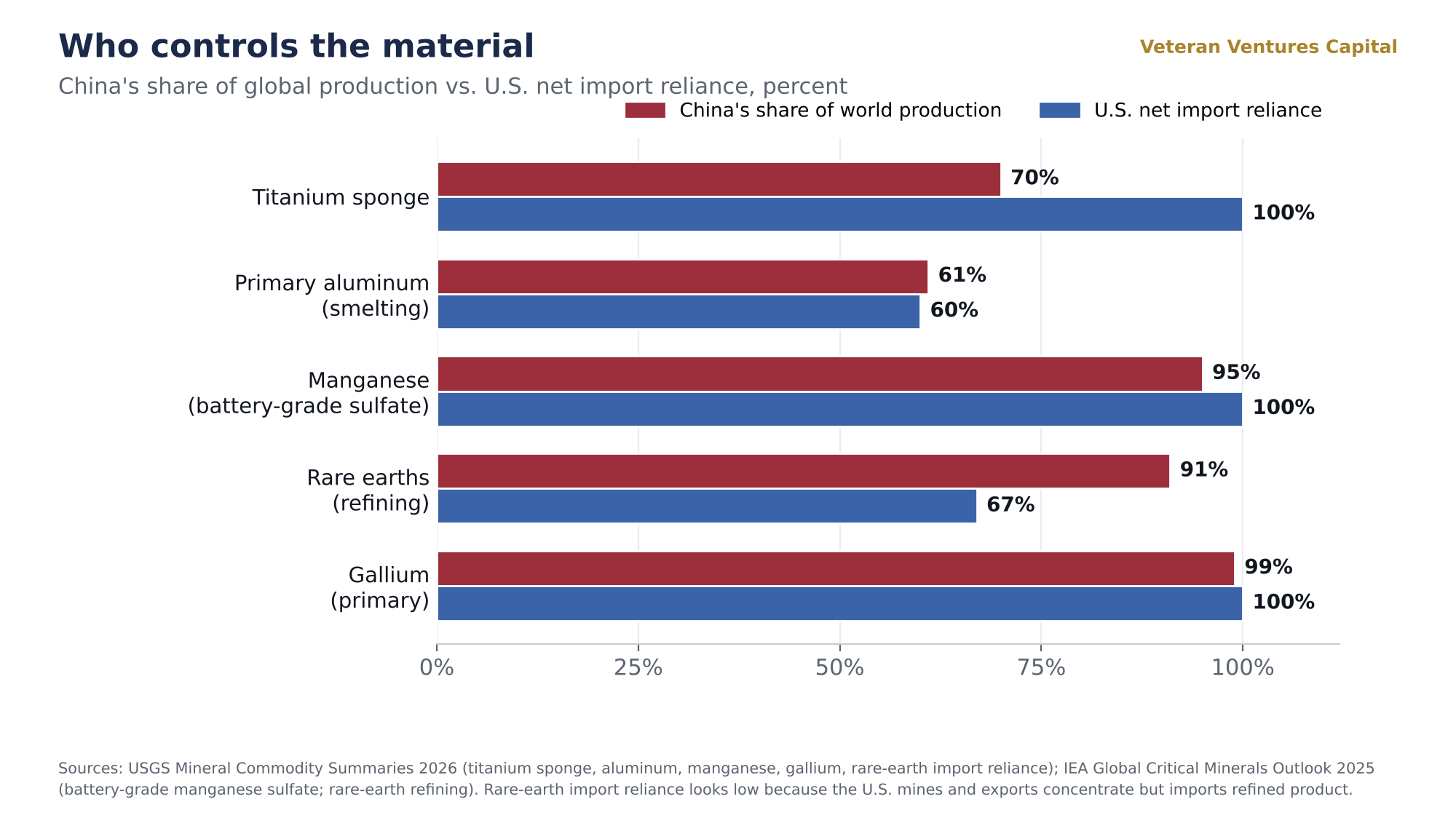
The problem extends well beyond titanium. China accounts for approximately 61 percent of global primary aluminum production, 91 percent of rare-earth refining, and 95 percent of battery-grade manganese sulfate production.
These materials are essential to aircraft, precision-guided munitions, unmanned systems, advanced batteries, and countless commercial applications. Their availability directly influences America's ability to manufacture the technologies necessary for national defense.
The war in Ukraine provides a particularly revealing example. Ukraine has developed an extraordinary domestic drone industry, producing millions of aircraft annually. Yet many of the components required to build those drones still originate in China, including motors, magnets, batteries, and flight controllers.
When Beijing restricted exports of certain drone components in 2024, Ukrainian manufacturers reported prices tripling as they scrambled to identify alternate suppliers.
This illustrates a fundamental vulnerability. It matters little how innovative your engineers are if a geopolitical competitor can restrict access to the components required to manufacture their designs.
The solution is not necessarily to reproduce every foreign supply chain domestically. That would be economically impractical. Instead, we need diversification through domestic production, allied sourcing, material substitution, and technologies that reduce dependence on scarce inputs.
For venture investors, the opportunity lies in technologies that eliminate critical dependencies rather than simply rearranging them.
A new material that substitutes for an imported metal, a domestic production process that replaces an overseas supplier, or a manufacturing technique that uses readily available feedstocks can materially improve supply-chain resilience.
These innovations also have an important commercial advantage: they can serve customers far beyond the defense industry.
2. Liquidity and Access Risk: When the Material Exists but We Cannot Get It
In financial markets, an asset can have tremendous theoretical value but limited practical utility if it cannot be converted into cash when needed.
Industrial materials face a similar challenge. A material may exist, and a supplier may be willing to sell it, but that does little good if delivery takes two years or available production cannot meet demand.
In national security, lead time is a strategic variable. Consider hypersonic weapons.
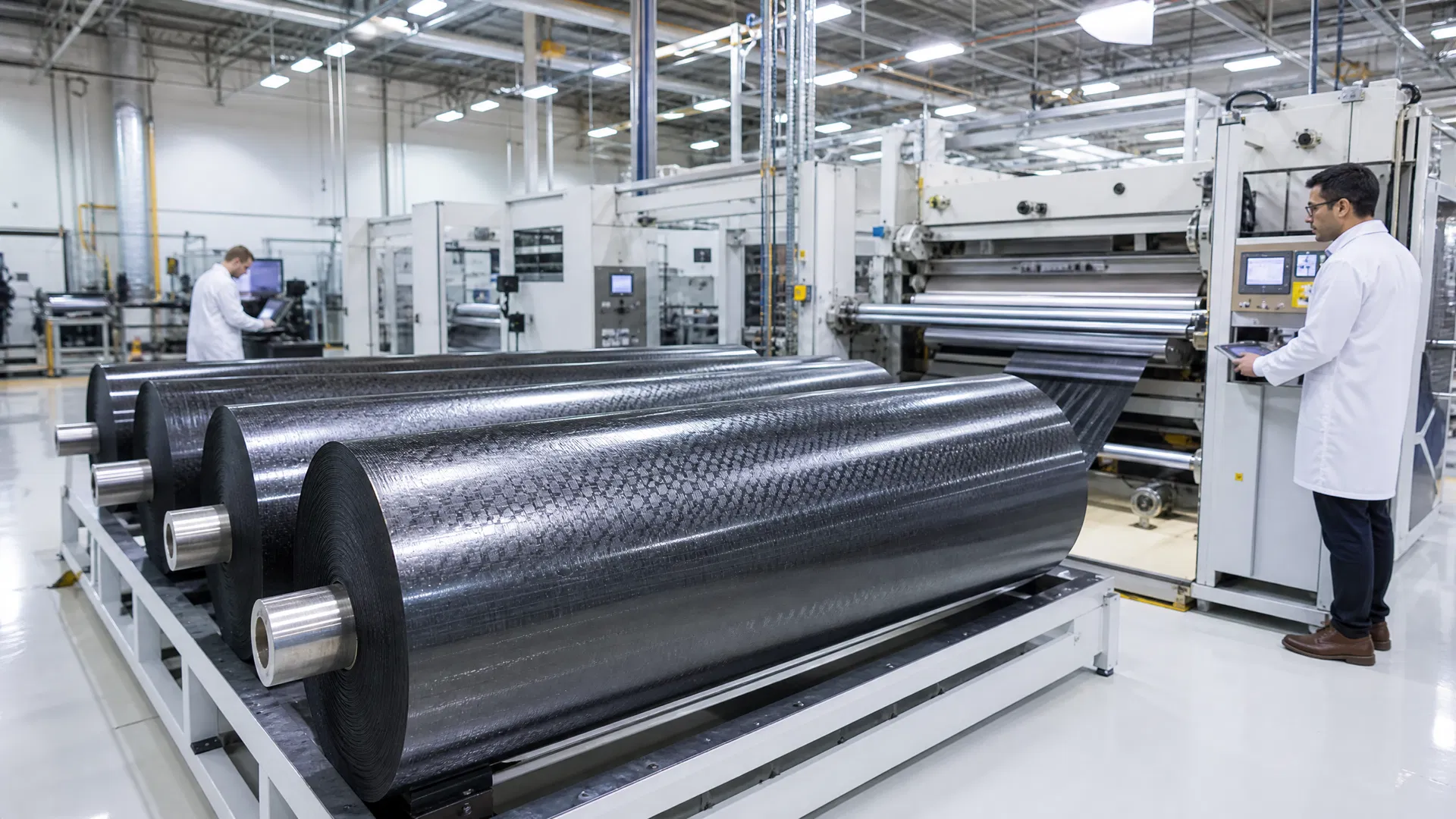
Vehicles traveling faster than Mach 5 experience extraordinary thermal stress. Carbon-carbon composites and ultra-high-temperature ceramics are among the materials capable of surviving these conditions. Yet conventional carbon-carbon production can require multiple densification cycles over many months.
A 2023 National Defense Industrial Association study identified just three domestic carbon-carbon suppliers and concluded that existing capacity could not support hypersonic weapons production at scale.
The issue is not whether the material works. It is whether we can produce enough of it, quickly enough, to support operational requirements.
The same problem increasingly affects commercial markets.
Aerospace engine manufacturers face extended production timelines for highly specialized components, including turbine blades and vanes. Demand has accelerated further as data centers drive investment in gas-fired power generation.
By mid-2026, GE Vernova reported a combined gas-turbine backlog and slot reservations of 116 gigawatts, while Siemens Energy described lead times extending three years or longer.
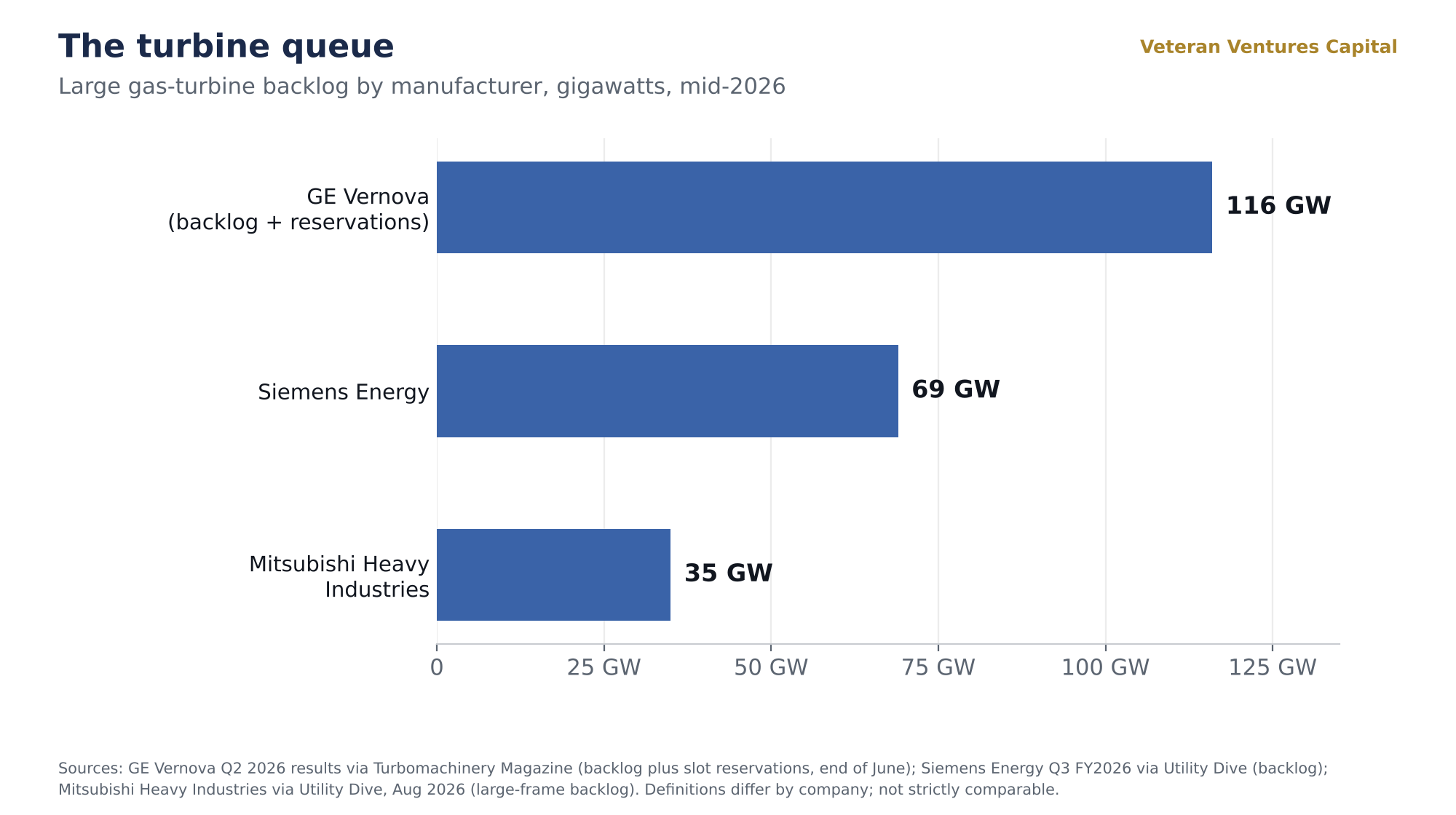
These are not merely procurement inconveniences. They represent constrained production capacity, delayed revenue, and potentially significant opportunity costs.
The distinction matters for investors. A company does not necessarily need to invent a revolutionary new material to create significant value. It may instead develop a way to produce, qualify, or deliver an existing high-performance material in weeks rather than months.
Materials qualification is particularly important. Historically, qualifying a new composite system for an aerospace platform could require years and substantial expense. Even technically superior materials can struggle to reach market because the process of proving their reliability is too slow.
Advances in computational materials science, artificial intelligence, and integrated manufacturing offer the potential to compress these timelines.
For defense customers, shorter lead times mean greater readiness and the ability to respond to emerging requirements. For commercial customers, they mean less working capital tied up in inventory, faster production, and improved competitiveness.
A material that cannot be delivered on time is often no more useful than a material that does not exist.
3. Cost and Production Risk: When We Cannot Manufacture at Scale
The third challenge may be the most difficult because it requires confronting the economics of production.
America knows how to make sophisticated materials and weapons systems. The question is whether we can manufacture them affordably and in quantities sufficient for sustained competition.
The war in Ukraine has demonstrated the importance of affordable mass. An inexpensive drone costing several hundred dollars can destroy military equipment worth millions.
Ukraine's manufacturers have responded by matching materials to mission requirements. Its AQ-400 Scythe long-range strike drone, for example, uses plywood components that can be manufactured in furniture factories.
That is an important lesson. The most technically advanced material is not necessarily the right material. The winning solution is the one that meets the mission requirement at a sustainable cost and production rate.
American munitions manufacturing demonstrates the other side of this challenge.
Before Russia's full-scale invasion of Ukraine, the United States produced approximately 14,000 155-millimeter artillery shells per month. The Army subsequently established a goal of 100,000 monthly rounds, committing billions of dollars to expand production.
Despite that investment, production remained well below the target in early 2026.
The constraints are not limited to funding. They include specialized steel forging, explosives production, industrial equipment, qualified manufacturing processes, and the workforce required to operate them.
The United States has not produced TNT domestically since the 1980s. Its first new production facility is not expected to begin operating before 2027. Nitrocellulose, a critical component of propellants, also depends on a highly concentrated domestic supply base.
These are difficult problems to solve simply by writing larger procurement checks.
At VVC, we often describe this disconnect with a straightforward observation:
Demand is funded. Capacity is not.
Government investment and defense procurement create important demand signals, but they do not automatically establish the industrial capacity necessary to fulfill that demand.
That capacity must be developed through investment in manufacturing technologies, production processes, qualified materials, and skilled labor.
The commercial market faces many of the same challenges. Manufacturers across aerospace, energy, automotive, and industrial equipment are seeking ways to reduce part counts, shorten production cycles, decrease material waste, and improve performance.
Advanced manufacturing technologies, including additive manufacturing and new composite production methods, can change the underlying cost structure of these industries.
For venture investors, this is particularly attractive when a technology offers a measurable economic advantage: lower unit costs, faster throughput, reduced capital intensity, or better performance without corresponding increases in expense.
The opportunity is not simply to manufacture more of the same things. It is to change the economics of how those things are made.
Building a Better Materials Portfolio: Where VVC Is Investing
Veteran Ventures made three conviction investments in this vertical already, allocating capital to Cambium USA, Hybron, and most recently, leading the first institutional round with Radian Forge. We intend to make more.
We’re particularly bullish on any materials that are drop-in replacements for titanium, aluminum, manganese and other expensive and foreign-sourced metals. The rationale here is purely timelines and security—domestically sourced materials that can replace these metals allows our industries to more quickly and easily procure them. We’re also keenly interested in advanced ceramics, improved adhesives and spray-on additives; the rationale here is that advances in these types of materials unlock innovation in design, performance and down-stream manufacturing innovations simply not available in traditional materials. Finally, we continue to search for those innovative companies developed advanced manufacturing techniques that unlock new ways to deal with materials, either through waste reduction, ability to build ever more complicated geometries, or scale at mass despite a worsening labor shortage.
It bears repeating here—materials are the layer underpinning a wide range of potential downstream innovation opportunities. When engineers have broader choices at this fundamental layer of design, opportunities unlock across performance, cost, and scale that simply are not available with a smaller quiver of material arrows.
The Choice Ahead
Kelly Johnson's engineers had to invent the material, invent the method and, for a time, buy the metal from the adversary.
The task now is much more complicated, as both commercial and defense segments produce a much wider array of platforms critical to every day living. A thriving nation must have access to the entire materials spectrum, from plywood to carbon-carbon, at the volume and velocity the modern world demands.
In 1960, we bought some of our titanium from the Soviet Union because we had no choice.
This time, VVC intends to help create one.
Share this article
Know someone who would find this valuable? Share it on LinkedIn.
Get updates like this in your inbox.
Subscribe to our newsletter — insights on defense tech, portfolio companies, and what we're watching.

Computational material discovery to production