The Pentagon Is Becoming a Capital Allocator and Dual-Use Founders Need to Adapt

For decades, most founders thought about the Department of Defense primarily as a customer. That is still true. But it is no longer the whole story.
In today’s national security innovation ecosystem, the Pentagon is increasingly becoming something more: a market-shaping capital allocator. Through initiatives such as the Office of Strategic Capital, SBIC Critical Technology, APFIT, SBIR/STTR, DIU pathways, and other transition-focused programs, the government is beginning to play a more deliberate role in helping critical technologies move from prototype to production. For dual-use founders, this shift matters.
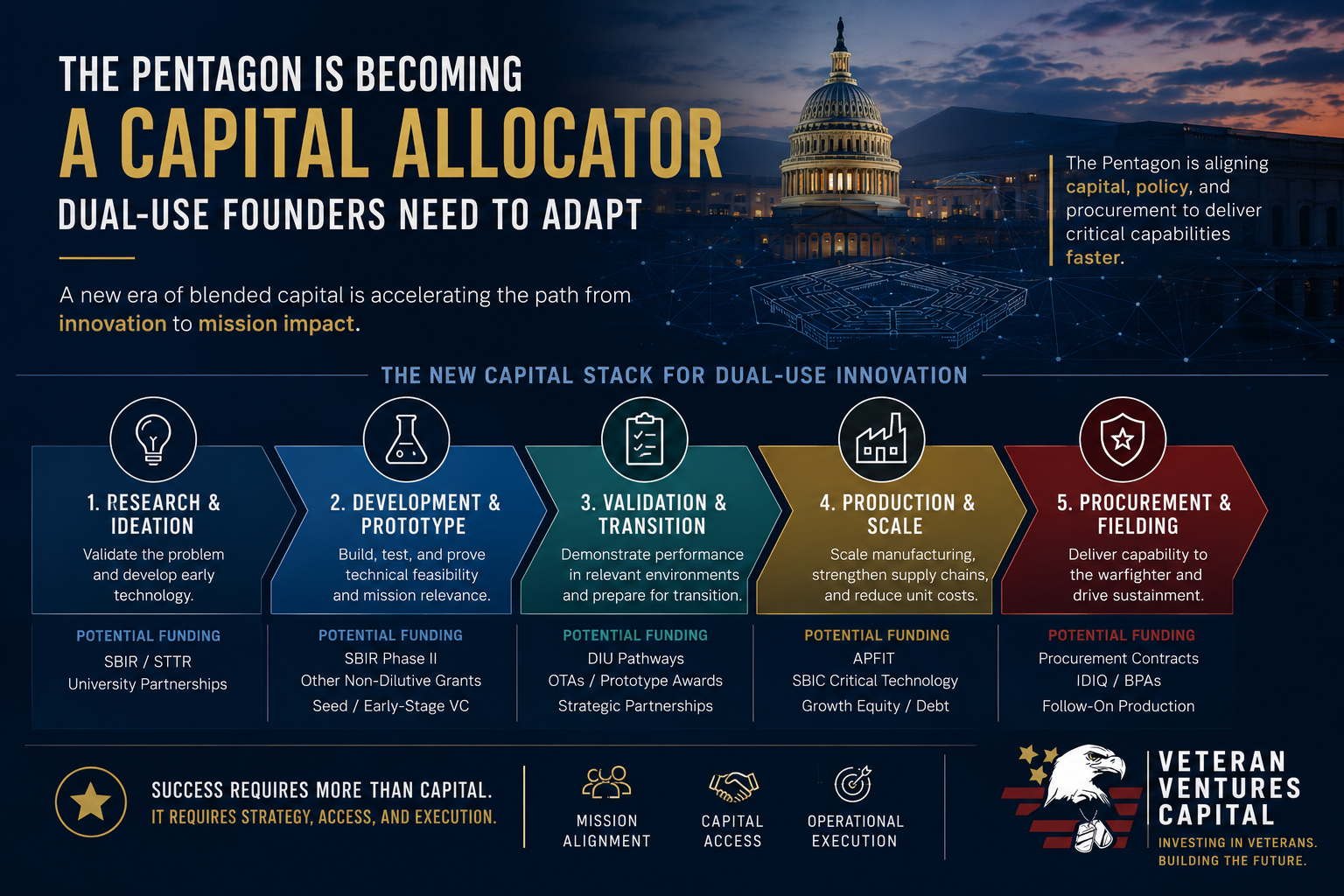
The old venture playbook was relatively straightforward: raise equity, build product, find customers, raise more equity, scale. That model still works in many commercial markets. But in defense and national security, the capital stack is more complex. The best companies are not just raising venture dollars. They are learning how to sequence private capital, non-dilutive funding, procurement dollars, strategic partnerships, and scale financing into a coherent growth strategy. That is not just finance. In defense tech, it is go-to-market strategy.
The capital stack is changing
The Office of Strategic Capital was created to help attract and scale private capital into technologies important to national security. Its work includes the SBIC Critical Technology Initiative, a joint DoD/SBA effort designed to increase private investment in critical technologies, supply chain capabilities, component-level technologies, and production processes vital to U.S. economic and national security.
That matters because many dual-use companies do not fail because the technology is uninteresting. They fail because the financing path does not match the market they are trying to serve.
A commercial software company can often iterate quickly, sell into a known buyer base, and use revenue growth to support the next financing round. A national security company may need to move through a much more complicated path: technical validation, customer discovery, prototype funding, test and evaluation, integration, production readiness, procurement, and long-term sustainment. That path requires capital. But not all capital plays the same role.
Venture equity can fund team growth, product development, commercialization, and speed. Non-dilutive funding can validate technical relevance and extend runway. Procurement dollars can become the bridge from experiment to deployment. Government-backed financing and strategic credit can help companies scale production capacity without relying solely on repeated equity dilution.
For founders, the strategic question is no longer simply, “How much money can I raise?” The better question is, “What type of capital should I use at each stage of the company’s development?”
Non-dilutive capital is no longer a side quest
Many founders still treat federal funding as a distraction. That can be a mistake.
SBIR and STTR programs are designed to provide non-dilutive funding for small businesses developing technology and moving toward commercialization. The federal SBIR/STTR program describes itself as America’s Seed Fund, awarding non-dilutive funding to help small businesses develop technology and chart a path toward commercialization. The DoD SBIR/STTR program is structured around a competitive three-phase process for research, development, production, services, or combinations of those activities tied to agency needs and missions.
For the right company, this funding can do more than extend runway. It can create customer engagement, validate mission relevance, and provide a forcing function for product maturity.
The same logic applies further down the transition pathway. APFIT, the Accelerate the Procurement and Fielding of Innovative Technologies program, was created to provide procurement funding to projects that have completed development and are ready to transition into operational use. Awards typically range from $10 million to $50 million and are intended to help small businesses and nontraditional performers accelerate initial production and reduce procurement timelines. Recent FY 2026 APFIT activity pushed the program past $1 billion awarded to small businesses and nontraditional defense contractors, according to DoD’s announcement. That is a meaningful signal.
The government is not just funding science projects. It is increasingly looking for ways to move validated technologies into production and operational use.
DIU and the commercial technology bridge
DIU remains one of the clearest examples of the government trying to bring commercial technology into the defense ecosystem at speed. DIU describes its mission as accelerating DoD adoption of commercially derived technology at speed and scale.
The significance of DIU is not just that it opens a door for commercial companies. It is that it reflects a broader shift in how the Department thinks about innovation. Instead of assuming all relevant technology must be created inside the traditional defense industrial base, the government is increasingly recognizing that critical capabilities may already exist in the commercial market. That creates opportunity, but also confusion.
A dual-use founder cannot simply say, “We have commercial traction, therefore DoD should buy from us.” Nor can they assume that a prototype award automatically becomes a program of record. The bridge from commercial technology to defense adoption still requires customer discovery, mission fit, security considerations, integration planning, contracting fluency, and persistence. This is where experienced investors and operators matter.
Capital alone is not enough. Founders need help understanding which government pathways are relevant, which ones are distractions, how to avoid chasing every opportunity, and how to preserve commercial discipline while pursuing defense adoption.
Why this matters for veteran founders
Veteran entrepreneurs often understand this environment in a way that is difficult to manufacture.
That does not mean every veteran founder is automatically prepared to build a successful dual-use company. They still need strong technology, a real market, disciplined execution, and the ability to raise capital. But many veterans bring a practical understanding of mission environments, operational constraints, and institutional decision-making.
They understand that the customer is not an abstraction. The end user may be a warfighter, an analyst, a maintainer, a commander, or a government program office trying to solve a real capability gap. That context matters.
In national security markets, founders must translate technology into mission relevance. They must understand not only what their product does, but why it matters, who needs it, how it will be used, and what has to happen before it can be fielded.
This is one reason Veteran Ventures Capital focuses on veteran-led, dual-use technology companies serving national security and commercial markets. VVC’s public positioning centers on defense and national security investing, with portfolio activity across space, autonomy, undersea, cybersecurity, ISR, and advanced materials, and more than $250 million in non-dilutive government capital secured across its portfolio. VVC’s Fund II announcement also emphasized the firm’s role in helping companies unlock non-dilutive capital, scale defense go-to-market strategies, and build resilient operations. That model fits the moment.
The founder takeaway
The Pentagon’s evolving role as a capital allocator does not make defense tech easy. In some ways, it makes the environment more complicated.
There are more programs, more pathways, more sources of capital, and more ways for founders to spend time in the wrong places. A company can win grants and still fail to build a scalable business. It can secure prototype funding and still never transition. It can attract venture dollars and still run out of time waiting for procurement to catch up. The winners will be the companies that are deliberate.
They will understand when to use equity and when not to. They will pursue non-dilutive funding when it supports the product roadmap, not when it distracts from it. They will treat procurement as a strategic pathway, not an afterthought. They will build commercial discipline while learning to navigate government demand.
Most importantly, they will recognize that in national security markets, capitalization strategy and go-to-market strategy are connected.
The Pentagon is not becoming a venture capital firm in the traditional sense. But it is becoming a more active participant in shaping where capital flows, which technologies scale, and how critical capabilities move into the hands of users. Dual-use founders should pay attention.
The companies that adapt to this new capital environment will have a real advantage. The ones that do not may find themselves with good technology, interested customers, and no practical path to scale.
That is the difference between innovation as an idea and innovation as national capability.
Sources
Office of Strategic Capital, U.S. Department of Defense https://www.cto.mil/osc/
SBIC Critical Technology Initiative, Office of Strategic Capital https://www.cto.mil/osc/sbicct-initiative/
America’s Seed Fund / SBIR-STTR Program https://www.sbir.gov/
DoD SBIR/STTR Program Overview https://www.defensesbirsttr.mil/SBIR-STTR/Program/
Accelerate the Procurement and Fielding of Innovative Technologies (APFIT), Office of the Under Secretary of Defense for Research and Engineering https://ac.cto.mil/apfit/
DoD Announcement: FY 2026 APFIT Projects Surpass $1 Billion Awarded https://www.war.gov/News/Releases/Release/Article/4366313/the-war-department-announces-first-round-of-fy-2026-apfit-projects-surpassing-1/
Defense Innovation Unit https://www.diu.mil/
Veteran Ventures Capital Closes Oversubscribed $60 Million Fund II Amid Record Aerospace & Defense Momentum, PR Newswire https://www.prnewswire.com/news-releases/veteran-ventures-capital-closes-oversubscribed-60-million-fund-ii-amid-record-aerospace--defense-momentum-302533707.html
Share this article
Know someone who would find this valuable? Share it on LinkedIn.
Get updates like this in your inbox.
Subscribe to our newsletter — insights on defense tech, portfolio companies, and what we're watching.