In the summer of 1940, with France collapsing and Britain bracing for invasion, Franklin Roosevelt summoned a 58-year-old roads-and-dams contractor named Henry J. Kaiser to Washington. Kaiser had never built a ship. Within three years, his yards were launching Liberty ships in days rather than months, applying assembly-line methods that traditional shipbuilders had dismissed as impossible. The lesson wasn't that the old yards lacked talent. The lesson was that when demand outruns the existing industrial base by an order of magnitude, the next chapter belongs to operators who can compress timelines that incumbents can't. Eighty-six years later, the United States and its allies are once again confronting a demand curve their industrial base cannot meet. The data tells the story.
Global defense spending reached $2.72 trillion in 2024 — the steepest annual rise since 1988, the height of the Reagan buildup. The United States now operates on its first-ever trillion-dollar defense budget, with an FY27 request of $1.5T that would mark the largest real increase since the late Cold War. Germany jumped 28 percent year-over-year and amended its constitutional debt brake to fund more. Japan logged a record budget for the twelfth consecutive year. South Korea raised defense R&D by nearly 20 percent. Poland is already past the NATO 2035 target of 5 percent of GDP. For the first time since the late 1980s, the U.S., Europe, and key Indo-Pacific allies are at record defense levels simultaneously — and 31 of 32 NATO members have now signed on to the 5 percent target.
What makes this moment structurally different from prior cycles is the gap between what allies have committed to spend and what their own factories can produce. Three decades of European underinvestment cannot be reversed in three years. According to Goldman Sachs, 64 percent of European NATO procurement currently flows to U.S. suppliers, and even as the EU scales toward an €800 billion target by 2030, its industrial base today sits at €183 billion — fragmented across thirty nations with no economies of scale. The bluntest illustration: Russia produces in three months what NATO produces in a year, in artillery shells. Demand is funded. Capacity is not. That gap is the investable thesis, and it will not close on the timeline policymakers wish it would.
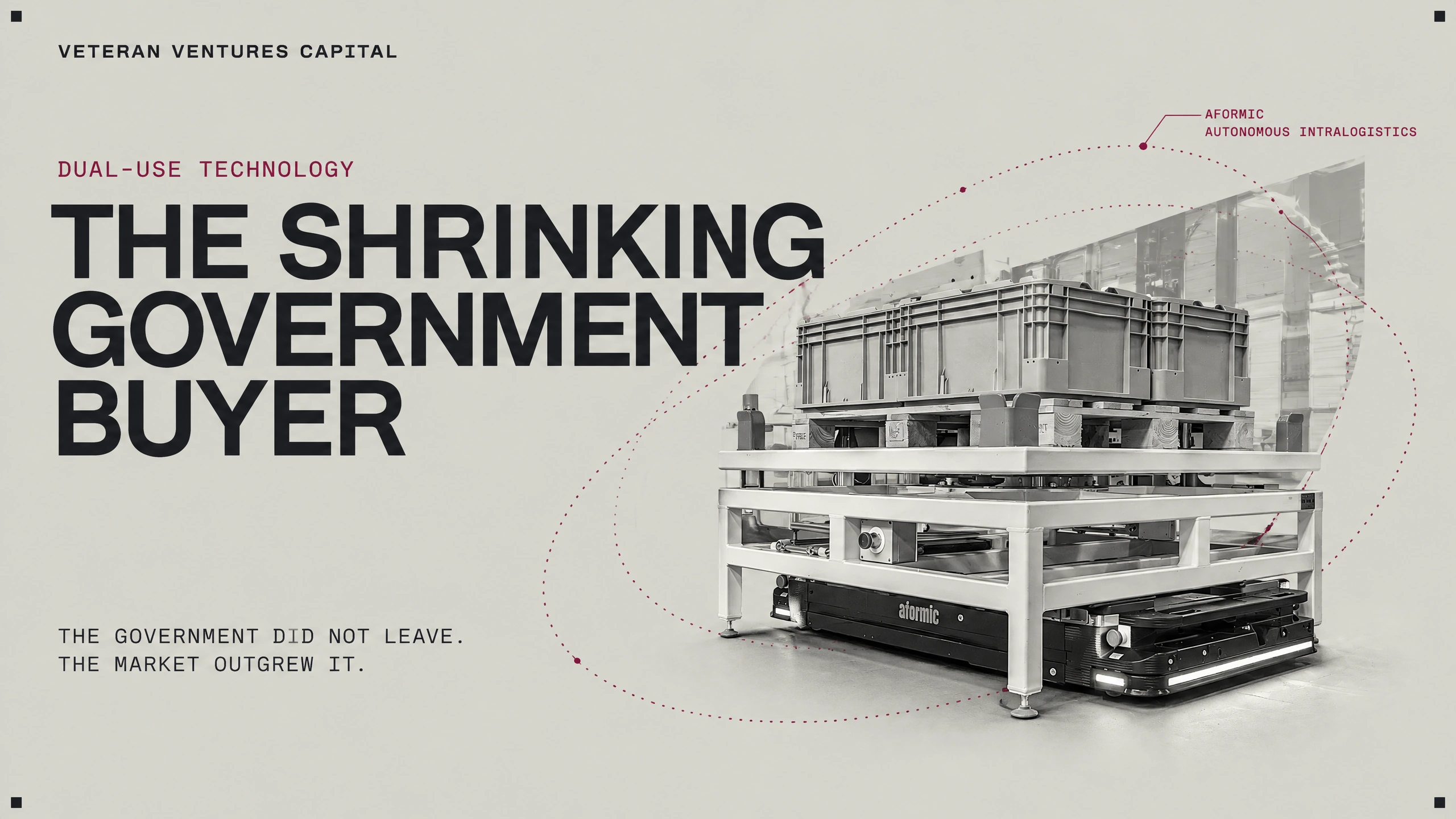
The four verticals Veteran Ventures Capital was purpose-built to back — space, maritime, robotics and autonomy, and advanced materials — share a quiet but decisive feature: each serves both defense and commercial buyers from the same production lines. The global space economy is now $613 billion, of which 78 percent is commercial. Anduril's maritime joint venture with HD Hyundai and Edison Chouest draws on the same Tier-2 supply chain that builds workboats and oil-service vessels. The DoD-funded ARM Institute explicitly targets dual-use because defense alone cannot justify the capital expenditure. The composites and high-temperature polymers that go into hypersonics are the same materials feeding Boeing and Airbus's combined 15,461-aircraft commercial backlog — more than eleven years of production. Single-customer concentration risk, the historical hazard of pure-play defense investing, is meaningfully attenuated when the customer set is this wide.
Beneath these tailwinds runs a quieter constraint, and it is the one most investors are still mispricing: capital is abundant, but labor and industrial capacity are not. By 2033, the National Association of Manufacturers projects a 1.9-million-worker shortfall in U.S. manufacturing. The average age of the defense manufacturing worker is 55, with a retirement wave imminent. The legacy primes cannot hire fast enough; their backlogs already stretch into the next decade. The companies that win this cycle are the ones pairing technology leadership with vertically integrated production — Saronic's acquisition of the Gulf Craft shipyard and announced $300 million expansion, the re-commissioning of dormant yards for autonomous vessels, the Maritime Action Plan's target of 40 new ocean-going commercial vessels by 2030. These operators are compressing five-year timelines into eighteen months. They look, deliberately, like the Kaiser yards of this generation.
The liquidity environment has turned in kind. After a four-year drought, the exit window is open: global aerospace, defense, and security M&A reached $55.6 billion in 2025, up 19 percent year-over-year, with EBITDA multiples on precedent transactions running 13x to 22x as strategics pay premiums for capability rather than consolidation. Four A&D IPOs cleared the public markets in the past twelve months — Karman, Voyager Technologies, Firefly Aerospace, and York Space Systems — after a year in which not a single U.S. space IPO priced. Serial acquirers including TransDigm, HEICO, AeroVironment, L3Harris, CACI, Karman, and Voyager are stocking war chests for platform M&A. Q1 2026 deal volume is already pacing 37 percent ahead of Q1 2025, and deal value 166 percent ahead. The buyers are real, identifiable, and active.
And then there is the once-in-a-generation event sitting on the horizon. SpaceX filed confidentially on April 1 of this year, targeting a $1.75 trillion valuation and a $75 billion raise — 2.5 times the Saudi Aramco record and the largest single liquidity event in financial history. Combined with the pending offerings of OpenAI, Anthropic, Databricks, and Stripe, the next twelve months will cycle roughly $3.6 trillion in IPO pipeline value through to limited partners. An estimated $700 billion is expected to return to venture LPs in 2026 alone. The ex-SpaceX VCs already standing up funds — Interlagos at $550 million, Founders Fund, Gigafund, Alpine Space Ventures, Cantos — are positioned for re-deployment into the very verticals where VVC invests. The capital wave is forming. The question for allocators is which managers are positioned where it lands.
Veteran Ventures Capital is a veteran-led firm investing in dual-use technology, during the precise convergence of an allied defense surge, a commercial re-industrialization, and the largest liquidity cycle in modern finance. The strategic backdrop is both favorable and specific. The next chapter of aerospace and defense belongs to operators who can build what allies have ordered but cannot produce for themselves, and to the capital that backed those operators before the rest of the market understood what it was looking at. We've spent the last several years backing exactly those operators.
This is the market we were built for.
Share this article
Know someone who would find this valuable? Share it on LinkedIn.
Get updates like this in your inbox.
Subscribe to our newsletter — insights on defense tech, portfolio companies, and what we're watching.